
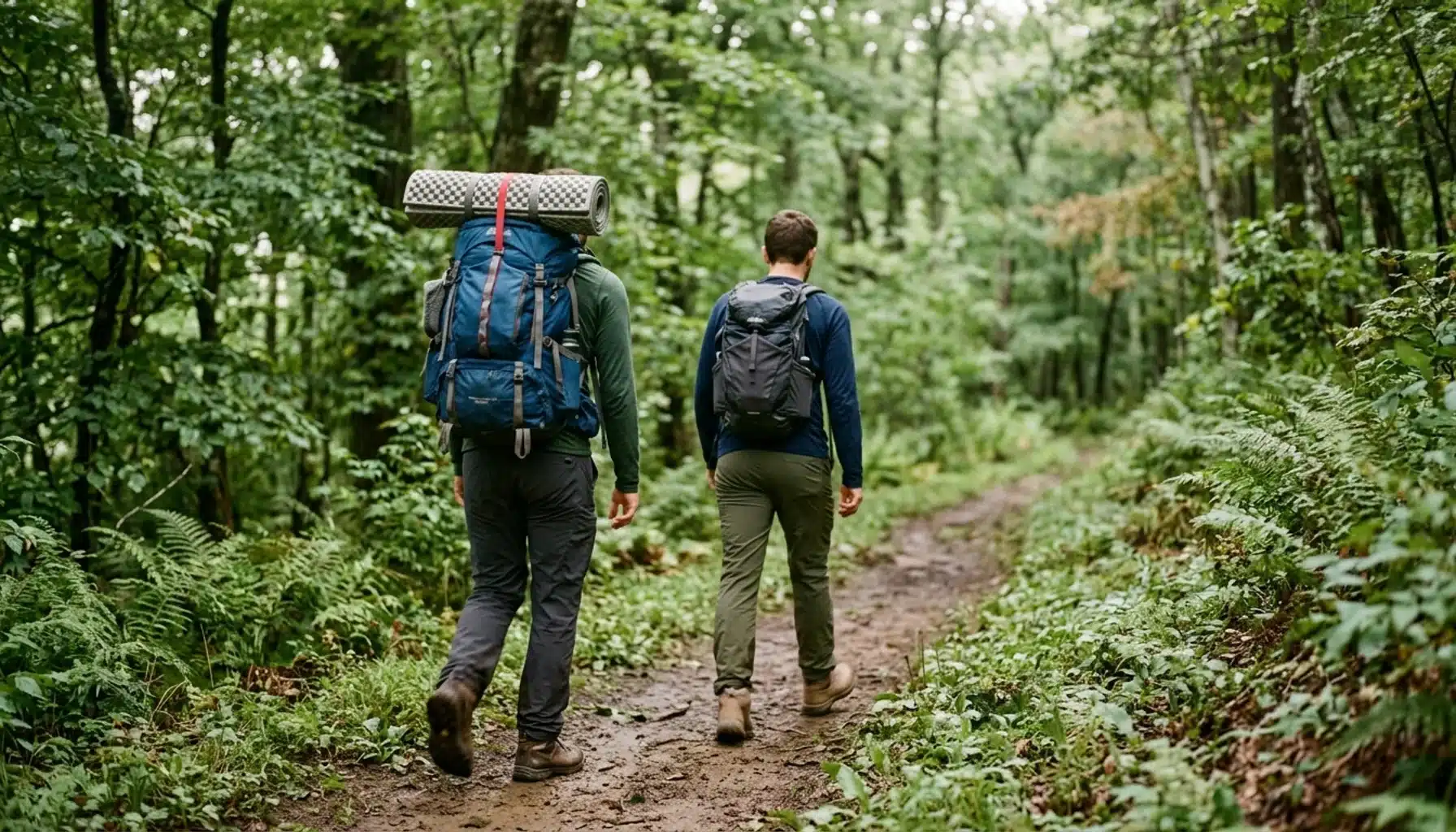
Hiking vs trekking comes down to time, terrain, and self-reliance. A hike is a walk on a marked trail that usually ends the same day, while a trek is a multi-day journey through remote or rugged country with overnights along the way. For most weekend travelers, hiking is the right choice, and Shenandoah National Park offers more than 500 miles of trails, according to the National Park Service. Royal Oak Retreat, our wellness cabin in Shenandoah Farms, adds a sauna, hot tub, and cold plunge for the recovery afterward.
Key Takeaways
- Hiking is walking on marked trails, typically 30 minutes to a full day, while trekking is a multi-day trip lasting several days to several weeks with overnight stays.
- The boundary is not standardized. Academy Sports uses 10 miles as a dividing line, and Salomon says altitude does not define trekking, so the most reliable test is whether you sleep out and how much support the route provides.
- Trekking is usually harder for beginners because daily hours, elevation gain, pack weight, and recovery all stack up across consecutive days.
- Blackrock Summit, listed by the NPS as easy at 1 mile round trip with 175 feet of elevation gain, is a good first Shenandoah hike.
- Royal Oak Retreat sits about 40 minutes from Shenandoah National Park and sleeps up to four adults-first guests, with a sunken hot tub, Scandinavian sauna, and cold plunge for post-trail recovery.
At Royal Oak Retreat, our guests often arrive from Washington D.C. on a Friday evening and ask the same question: should we hike something, or plan something bigger? The answer depends on how many nights you want to spend on the trail. For most couples and solo travelers in 2026, it is a day hike followed by a long soak.
This guide sorts out the hiking vs trekking question using definitions published by outdoor brands such as Salomon, then fills the gaps those pages leave: where the terms blur, how to judge your readiness, and which overnight style needs which gear.
Then we apply it locally. Shenandoah National Park welcomed 1.7 million visitors in 2026, according to the NPS, so the trail you choose shapes your crowd level as much as your fitness does.
What Is the Difference Between Hiking and Trekking?
Hiking is recreational walking on marked trails in natural settings, usually finished in a single day, while trekking is a multi-day journey through remote or rugged terrain with nights spent in tents, huts, or shelters. Outdoor brands describe hiking as anything from a 30-minute stroll to a full-day outing, and trekking as a commitment of several days to several weeks. Salomon frames trekking as hiking with duration and environment added: a mountain itinerary lasting several days, either a loop or a traverse.
No governing body fixes the line. Academy Sports uses numbers, placing hikes at 30 minutes to 3 hours and 10 miles or less, and treks at days or weeks and 10 miles or more. Other publishers say the two words overlap. Treat them as a spectrum, with sleeping out and route remoteness as the clearest markers.
What Is the Difference Between Hiking and Trails?
A trail is the physical route, and hiking is the act of walking it. Shenandoah’s trails are blazed and maintained, in part by volunteers from the Potomac Appalachian Trail Club, which is why a hike there demands far less navigation skill than a trek over unmarked ground.
Is Trek the Same as Hike?
A trek is a hike taken far enough, long enough, and remotely enough to require overnight self-sufficiency, so the words overlap without being identical. Fit&Well quotes Claire Ramsdell, adventure consultant at The Detour Effect, describing trekking as multi-day, higher-mileage travel with backcountry overnights, and hiking as the broader term that often means returning home that night.
Vocabulary also shifts by region. In the United States, trekking is frequently called backpacking, while elsewhere a trek may be a guided route with lodges. Salomon uses walking for gentler outings on easy ground.
Edge cases matter. T3 notes that routes such as Everest Base Camp and the Inca Trail, along with alpine hut-to-hut treks, can include water stops, food, and bunkhouses, so a supported trek can demand less self-reliance than an overnight hike where you carry everything. Old Rag Mountain, a one-day Shenandoah scramble, is the opposite case: a hike that feels like a trek in effort.
How Does Hiking vs Trekking Compare Side by Side?
A side-by-side look at hiking vs trekking shows differences in duration, distance, terrain, overnight needs, and route support. The table below combines figures from Academy Sports, T3, and Salomon, and the cutoffs are one publisher’s yardstick, not an official standard.
| Factor | Hiking | Trekking |
|---|---|---|
| Typical length | 30 minutes to a full day | Several days to several weeks |
| Distance | 10 miles or less (Academy Sports) | 10 miles or more, usually spread over days (Academy Sports) |
| Overnights | Usually none; return the same day | Tents, huts, or remote shelters |
| Terrain | Marked, accessible trails with hills, switchbacks, and rocky sections | Remote valleys, river crossings, and rocky, muddy, or snowy ground; sometimes off-trail |
| Pack | Daypack with water, food, and layers | Heavier load unless huts supply meals and bedding |
| Route support | Trailhead parking and signed junctions | Ranges from none to water stops, food, and lodges (T3) |
| Examples | Blackrock Summit, Dark Hollow Falls | Everest Base Camp, Inca Trail, alpine hut-to-hut routes |
How Long Does a Typical Hike or Trek Last?
A typical hike lasts from 30 minutes to a full day, while a typical trek lasts several days to several weeks. Academy Sports narrows the hike range to 3 hours or less, which suits short park walks but misses long day routes. A 12-mile day on a Shenandoah ridge breaks that distance figure without becoming a trek, because you still sleep in a bed that night.
For Shenandoah planning, the NPS lists Blackrock Summit at 1 mile round trip, and the Bearfence Rock Scramble reaches its summit in about 25 minutes. Both fit inside a morning. Daylight is the practical limit: in winter you have far fewer hours, so build a buffer and plan to be off the trail before dark.
If you want a longer plan, our full guide to hiking trails in Shenandoah National Park sorts routes by effort.
Is Trekking Harder Than Hiking for Beginners?
Trekking is typically harder than hiking for beginners because it stacks several demands: more hours on your feet each day, heavier packs, weather exposure, and recovery across consecutive days. Fit&Well notes that trekking terrain tends to be steeper and sustained over longer periods, sometimes at higher altitude. Indiahikes, which runs Himalayan treks, sorts its routes into moderate, moderate-difficult, and difficult categories because climbing and altitude gain vary so widely.
Length alone misleads, so judge readiness with five concrete criteria:
- Daily hours on your feet: Can you comfortably walk the same number of hours two days in a row?
- Elevation gain: Have you climbed sustained ascents, not just rolling terrain?
- Altitude exposure: Will the route climb high enough that you need to ask a doctor about it?
- Pack weight: Have you carried your planned load on a real trail, not just around the block?
- Recovery: How do your legs and feet feel the morning after a long day?
Our advice: skip the trek as a first outing. Do a half-day hike with your loaded pack, then a full day, then consider a single overnight. A demanding hike such as Old Rag can be harder than an easy hut-supported trek, so effort matters more than the label.
What Is the Difference Between Hiking and Trekking Boots?
Hiking boots and trekking boots differ mainly in support and stiffness. Hiking footwear is lighter and more flexible for day loads, while trekking boots are sturdier, with more ankle support for heavy packs and rough ground. Our pick for most Shenandoah day hikes is a broken-in pair of light boots or trail shoes, because the NPS lists Blackrock Summit at 175 feet of gain over 1 mile and the park’s popular day routes are maintained, blazed trails. Save stiff trekking boots for loaded multi-day carries, and break any new pair in over several short walks before your trip.
Overnight style changes your packing list more than the word trek does. T3 lists three common options, and each needs different sleeping and cooking equipment.
| Overnight style | What it means | Gear implication |
|---|---|---|
| Hut or bunkhouse | Bed or bunk in a shelter, sometimes with meals | Lightest pack; sleeping layer and personal items |
| Campsite | Designated spot with a tent | Tent, sleeping system, and cooking gear |
| Self-supported wild camp | You carry everything and choose your own stop | Heaviest pack; full navigation skills required |
In Shenandoah, backcountry camping requires a permit, so confirm current rules with the NPS before you plan any overnight.
What Are the Best Beginner Hikes Near Shenandoah Farms, Virginia?
The best beginner hikes near Shenandoah Farms are short, well-marked Skyline Drive trails with clear summit or waterfall payoffs, reached from the park roughly 40 minutes from Royal Oak Retreat. Skyline Drive has a posted speed limit of 35 mph at most, and mileposts count south from Front Royal at mile 0, so a trailhead far down the drive adds real driving time. Pick one trail per outing and leave margin.
As a planning rule, the 40 minutes to the park gets you to the entrance area only. At 35 mph or less, each additional 10 miles of Skyline Drive adds roughly 17 minutes or more, so a trailhead at milepost 84.4 is a long drive beyond the park entrance. Confirm current road conditions with the NPS before you leave the cabin.
Blackrock Summit
The NPS lists Blackrock Summit at milepost 84.4, 1 mile round trip, easy, with 175 feet of elevation gain. It is a gentle boulder-field summit. Because it sits far south on the drive, pair it with a day on the Luray side instead of a quick evening stop.
Bearfence Rock Scramble
The Bearfence Rock Scramble reaches summit views in about 25 minutes, but it needs your hands on the rock. Skip it if you are carrying a pack or nervous on heights, and check the NPS page first if you are bringing a dog.
Dark Hollow Falls
The Dark Hollow Falls trail is one of the park’s most popular waterfall walks. It is short, but the return climb is uphill, and weekend crowds build by late morning, so arrive early.
Dog owners should note that Shenandoah allows leashed dogs on most trails but restricts them on a handful, so check NPS rules before choosing. For rest days, Luray Caverns is a cool, flat alternative, and Fox Meadow Winery in Linden is about 5 minutes from the cabin, with Crimson Lane Vineyards in Hume about 8 minutes away. More ideas live in our nearby experiences page.
How Do You Choose Between a Hike and a Trek?
Choosing between a hike and a trek means matching your trip length, experience, and appetite for self-reliance to the route’s level of support. Start with the nights you have: one or two days points to hiking, and four or more days with training behind you points to trekking.
Here is a worked example. Say you have a three-day weekend, arrive Friday evening, and have never carried an overnight pack. Saturday, hike Blackrock Summit in the morning (1 mile, 175 feet of gain, per the NPS) and add Dark Hollow Falls in the afternoon if your legs feel good. Sunday, take a shorter walk and be back at the cabin by early afternoon for the sauna. That plan gives you two real hikes, no gear you do not own, and a built-in recovery block. If it feels easy, your next trip can add a loaded-pack day hike, then a single overnight, which is the sensible bridge to trekking. If a day on the trail already left you sore, you have your answer without risking a miserable multi-day trip.
- Couples on a weekend: Pick two day hikes and keep the evenings free.
- Solo and burnout-recovery travelers: One short hike a day, with long recovery blocks, beats a summit checklist.
- Dog owners: Choose trails after checking NPS pet rules, not before.
- Experienced backpackers: The park’s backcountry and the Potomac Appalachian Trail Club’s primitive cabins allow multi-night trips.
For a supported option inside the park, Skyland and Lewis Mountain Cabins let you link day hikes without carrying a tent. To compare bases outside the park, see which Shenandoah Valley town fits your trip.
Is Hiking or Trekking Safe for Everyone?
Hiking and trekking are safe for most healthy adults who plan for weather, fitness, and recovery, but they carry real risks for some people. Read these points before choosing your route, and talk to a doctor if any apply.
Physical Fitness Level: A route you cannot finish in daylight becomes a safety problem. Choose distance and gain you have already walked at home.
Weather Risks: Thunderstorms, cold fronts, and summer heat change quickly on ridges. Check the forecast, carry layers, and turn around early.
Altitude: Shenandoah’s elevations are modest, but treks at high altitude can cause illness. Ask a doctor if you plan one.
Navigation and Cell Service: Coverage can be patchy in the park, so carry a paper map and tell someone your route.
Heat and Cold Therapy Afterward: Sauna and cold plunge sessions are general wellness tools, not medical treatment. Hydrate, start gently, and skip them if you feel unwell. Check with a doctor first if you have heart or blood pressure conditions, or are pregnant.
Where Should You Recover After a Long Day on the Trail?
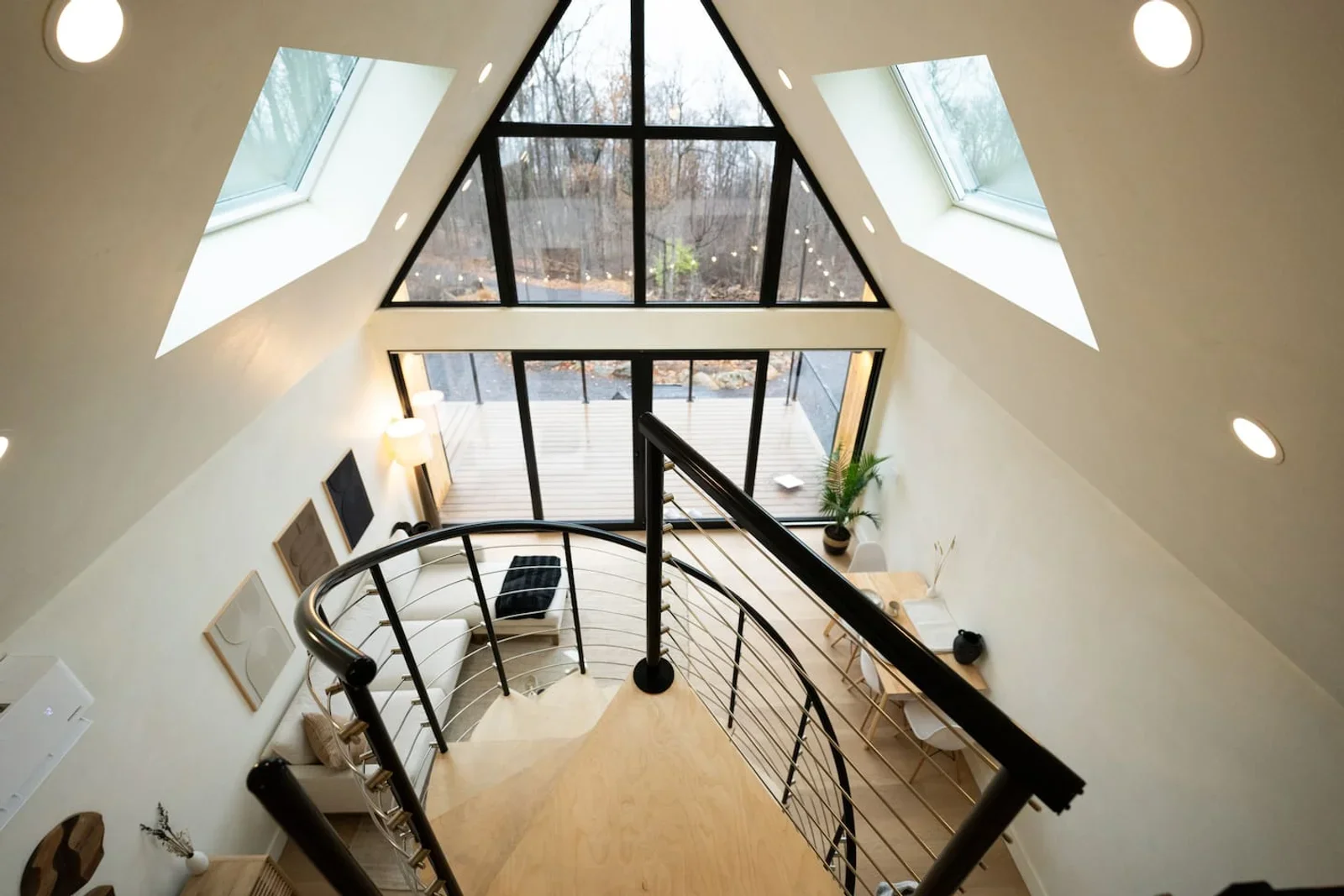
The best place to recover after a long day on the trail is somewhere quiet, warm, and close enough to the trailhead that you are not driving tired. Royal Oak Retreat is a cedar-clad cabin in the forests of the Front Royal and Linden area, about 40 minutes from Shenandoah National Park, with floor-to-ceiling windows facing the woods.
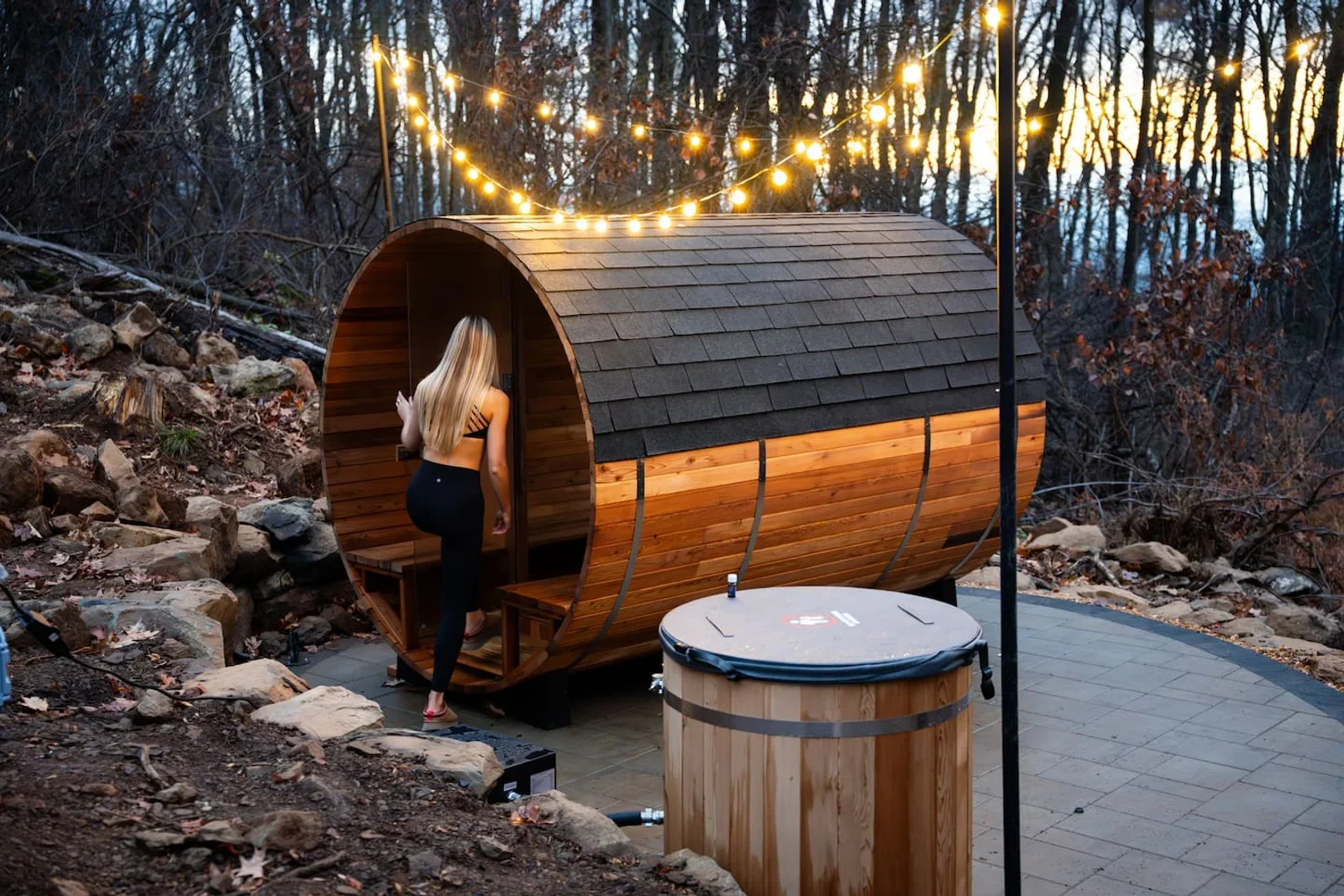
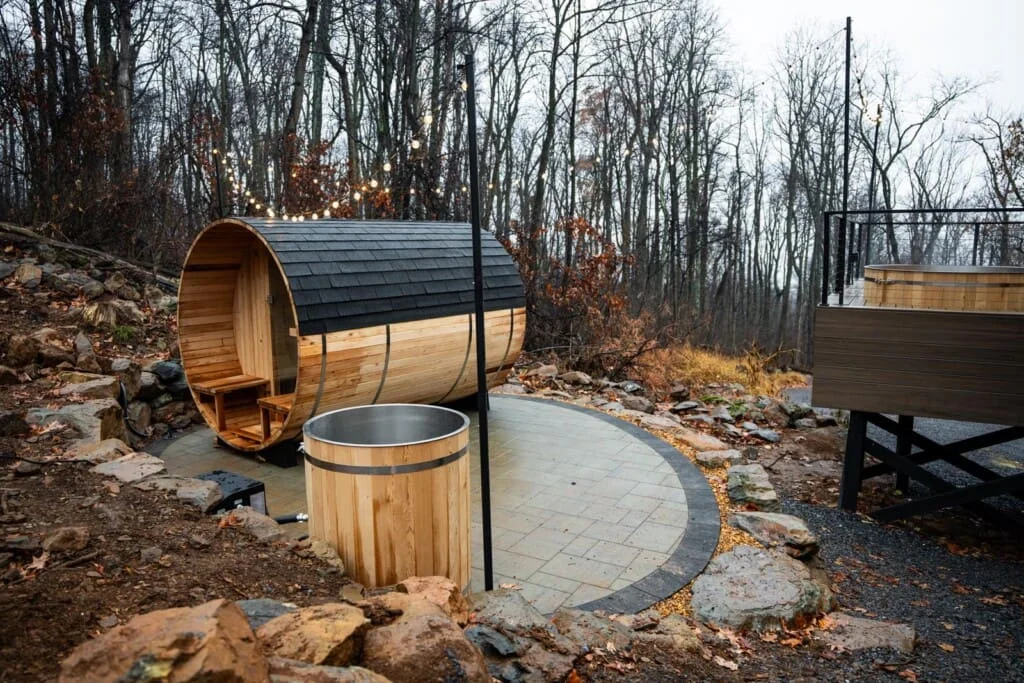
The cabin has a bedroom and a loft and sleeps up to four guests, with one bathroom. A sunken outdoor hot tub gives stargazing views, and a Scandinavian-style sauna and cold plunge share a dedicated contrast therapy island. Many guests alternate sauna and cold plunge rounds, resting between each, so start gently and listen to your body. The cabin is adults-first, so it suits couples and solo travelers.
Practical details matter after a hard hike. The loft queen bed is reached by a spiral staircase, so tired legs may prefer the king bed in the main bedroom. A 4×4 vehicle is required in winter months because of the steep driveway. Royal Oak Retreat welcomes one dog under 50 lbs, and has an on-site EV charger and Starlink internet.
Celebrating something? The Romance Package adds a layer to an anniversary weekend. If you are still comparing, our guide to Shenandoah Valley cabin rentals lays out the area.
So Which Should You Choose: A Hike or a Trek?
For most readers, the hiking vs trekking decision resolves in favor of hiking: a day on a marked Shenandoah trail, then a sauna and hot tub. Trekking suits you once you have trained with a loaded pack and want several nights on the trail. The reliable test is overnights and support, not miles, and as of 2026 Shenandoah’s 500-plus miles of trails give you room to build up. Whether you come for a short summit or a quiet weekend with no schedule, a slower pace pays off.
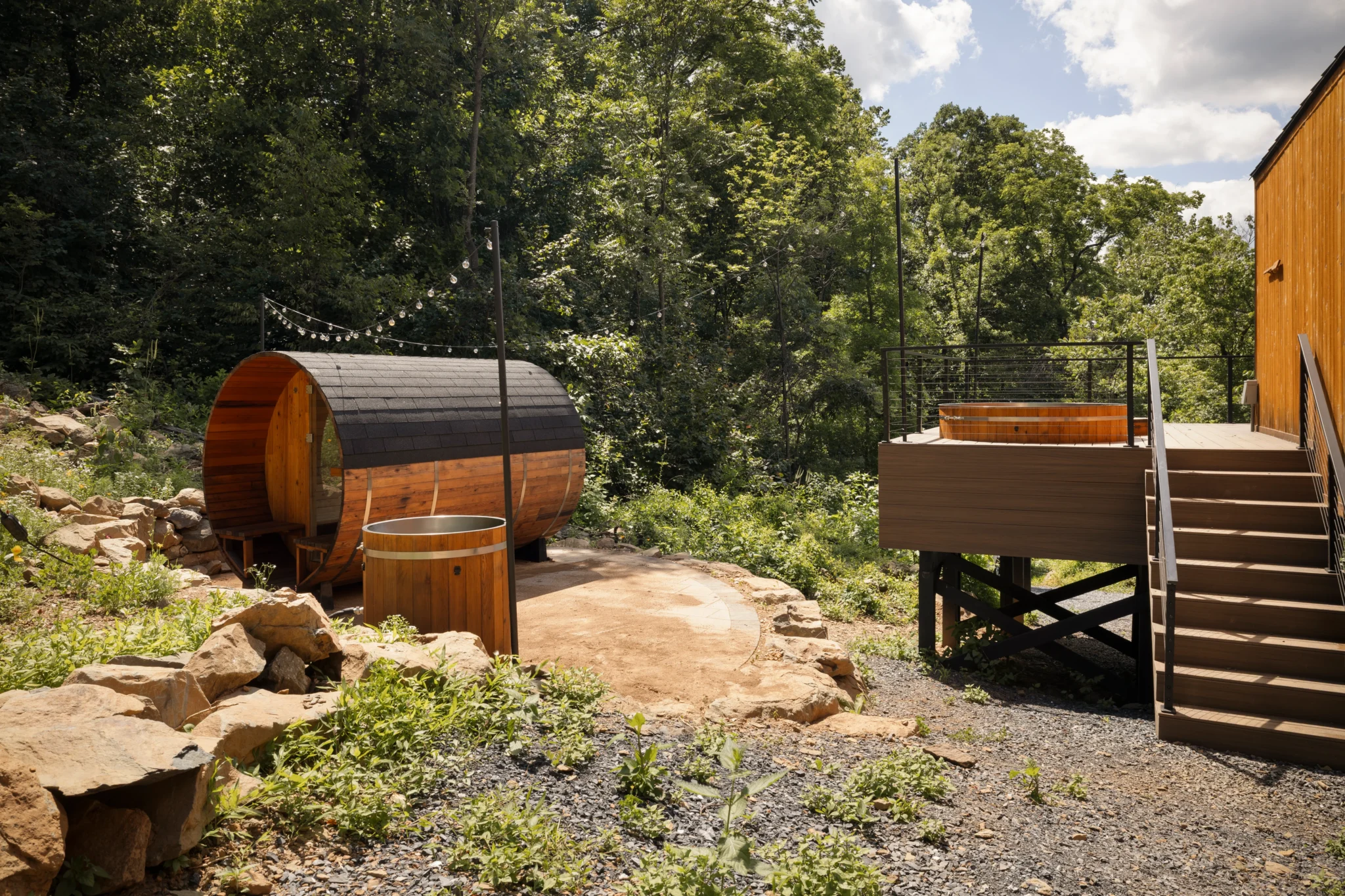
If this plan sounds like your kind of weekend, you can see the sunken hot tub and Scandinavian sauna at Royal Oak Retreat and check dates on our booking page.
Frequently Asked Questions
Is trek the same as hike?
Not exactly. A hike is a walk on marked trails, usually completed in one day, while a trek is a multi-day journey with overnight stays in remote or rugged terrain. In the United States, trekking is often called backpacking.
Is trekking harder than hiking for beginners?
Usually yes. Trekking stacks daily hours, elevation gain, pack weight, altitude, and recovery across consecutive days. Beginners do better starting with half-day and full-day hikes, then adding a single overnight.
How long does a typical hike or trek last?
Hikes last 30 minutes to a full day, and treks last several days to several weeks. Academy Sports places hikes at 30 minutes to 3 hours and 10 miles or less. These cutoffs are not official standards.
What is the difference between hiking and trekking boots?
Hiking footwear is lighter and more flexible for day loads. Trekking boots are sturdier, with more ankle support for heavy packs and rough ground. For most Shenandoah day hikes, broken-in trail shoes or light boots work well.
Which cabin is a good place to recover after hiking near Shenandoah National Park?
Royal Oak Retreat is an adults-first wellness cabin in Shenandoah Farms, about 40 minutes from Shenandoah National Park. It has a sunken outdoor hot tub, a Scandinavian-style sauna, a cold plunge, a fire pit, and sleeps up to four guests. Compare drive time, privacy, and recovery amenities when choosing any base.
Can I bring my dog on Shenandoah hikes?
Leashed dogs are allowed on most Shenandoah trails, but a handful of trails restrict them, so check the NPS rules before you go. Royal Oak Retreat welcomes one dog under 50 lbs.
What is the best time of year to hike Shenandoah with fewer crowds?
Weekdays, late winter, and the shoulder periods of early spring and late fall are quieter. Peak foliage in October brings heavy Skyline Drive traffic, so arrive early or choose a less-visited trail.
Content powered by inkSTR.co