

Does Virginia have four seasons? Yes. Virginia’s official tourism site describes the climate as mild with four distinct seasons: cool springs, humid summers, colorful falls, and winters that bring rain to the coast and real snow to the mountains. Where you stand, from Tidewater to the Shenandoah Valley, changes how each season feels.
Key Takeaways
- Virginia has four distinct seasons statewide, but the state spans five climate regions, so spring, summer, fall, and winter arrive with different intensity in the mountains than on the coast.
- Virginia Tourism reports January averages from 19-42 F in Northern Virginia to 35-48 F in Tidewater, and says mountain air runs about 10 F cooler than elsewhere in all four seasons.
- Snow varies by region and year. The National Park Service reports nearly 24 inches of average annual snowfall at Manassas, a local figure and not a statewide average.
- Fall color typically peaks October 15-25 in the Western Mountain region, which includes the Shenandoah Valley, and October accounts for roughly 24% of Shenandoah National Park’s annual visitation.
- Royal Oak Retreat, a luxury wellness cabin in Front Royal, sits about 40 minutes from Shenandoah National Park. Its sauna, cold plunge, and sunken hot tub suit every season, and a 4×4 vehicle is required in winter.
Anyone planning a 2026 trip to Virginia ends up asking some version of this question, because a January weekend in Richmond looks nothing like one on a Blue Ridge ridgeline. The short answer holds across the state: spring, summer, fall, and winter all show up on schedule. The longer answer depends on elevation and distance from the Atlantic.
Royal Oak Retreat, a luxury wellness cabin in the forests of Front Royal and Shenandoah Farms, sits about 40 minutes from Shenandoah National Park. That places it squarely inside the Valley’s seasonal swing: foliage in October, snow on the ridges in winter, and warm, humid evenings in July. Guests often ask which season suits a stay best, so this guide answers that too.
Below you will find regional temperature ranges from Virginia Tourism, local snow data from the National Park Service, a November weather rundown, and a step-by-step planning list with a quick-reference table.
Does Virginia Have Four Seasons Across the Whole State?
Virginia has four seasons in every region, each marked by a clear shift in temperature and scenery. Spring and fall bridge the hot summers and cold winters. The state’s official Fast Facts page calls the climate mild with four distinct seasons, and Fairfax County’s climate and local conditions page says Virginia’s extremes let residents enjoy all four.
Meteorologists classify most of Virginia as humid subtropical, according to Virginia Places. That label explains the hot, sticky summers. It also explains winters that rarely stay frozen for long. Fairfax County describes spring and fall as glorious and extended, which matches what you see on the ground: long, gentle shoulder seasons on both ends of summer.
| Season | Typical window | What defines it | Regional difference |
|---|---|---|---|
| Spring | March through May | Warming days, cool nights, frequent showers | Mountains tend to green up a few weeks after the Piedmont |
| Summer | June through August | Heat, humidity, afternoon thunderstorms | Mountain air runs cooler than the lowlands |
| Fall | September through November | Lower humidity, foliage, crisp mornings | Color peaks first in the mountains, last on the coast |
| Winter | December through February | Cold snaps, ice, and snow storms | Coast tends toward rain; mountains see more snow |
Meteorological seasons use tidy three-month blocks starting March 1 and June 1. The others begin September 1 and December 1. Residents feel seasons differently. Virginia Places notes that the coldest days often arrive weeks after the shortest day in December, so winter feels strongest in January and early February. As of 2026, those local rhythms still guide when Virginians plant and hike. They also guide when people travel.
How Do Virginia’s Five Climate Regions Change the Seasons?
Virginia has five climate regions, according to Virginia Tourism: Tidewater, Piedmont, Northern Virginia, Western Mountain, and Southwestern Mountain. Elevation and distance from the Atlantic Ocean drive the differences. Virginia Tourism also says mountain air is, on average, about 10 degrees F cooler than air in other parts of the state during all four seasons.
| Region | January average (degrees F) | July average (degrees F) | Typical foliage peak |
|---|---|---|---|
| Tidewater | 35-48 | 71-85 | October 20-31 |
| Piedmont | 27-47 | 68-88 | October 15-25 (western), October 20-31 (eastern) |
| Northern Virginia | 19-42 | 61-86 | October 15-25 |
| Western Mountain | 27-45 | 65-87 | October 15-25 |
| Southwestern Mountain | 24-44 | 60-85 | October 10-20 |
Read the table as a map of tradeoffs. Tidewater has the mildest winters, the Piedmont the hottest summers, and Northern Virginia the coldest January lows. Source for every figure above: Virginia Tourism’s seasons and climate guide.
These are regional averages, not guarantees. A cold front can drop a Tidewater afternoon well below its January range, and a warm spell can push a mountain town past its July range. Foliage dates are typical windows that shift with rainfall and early frosts.
What Is the Climate Like in the Shenandoah Valley Through the Year?
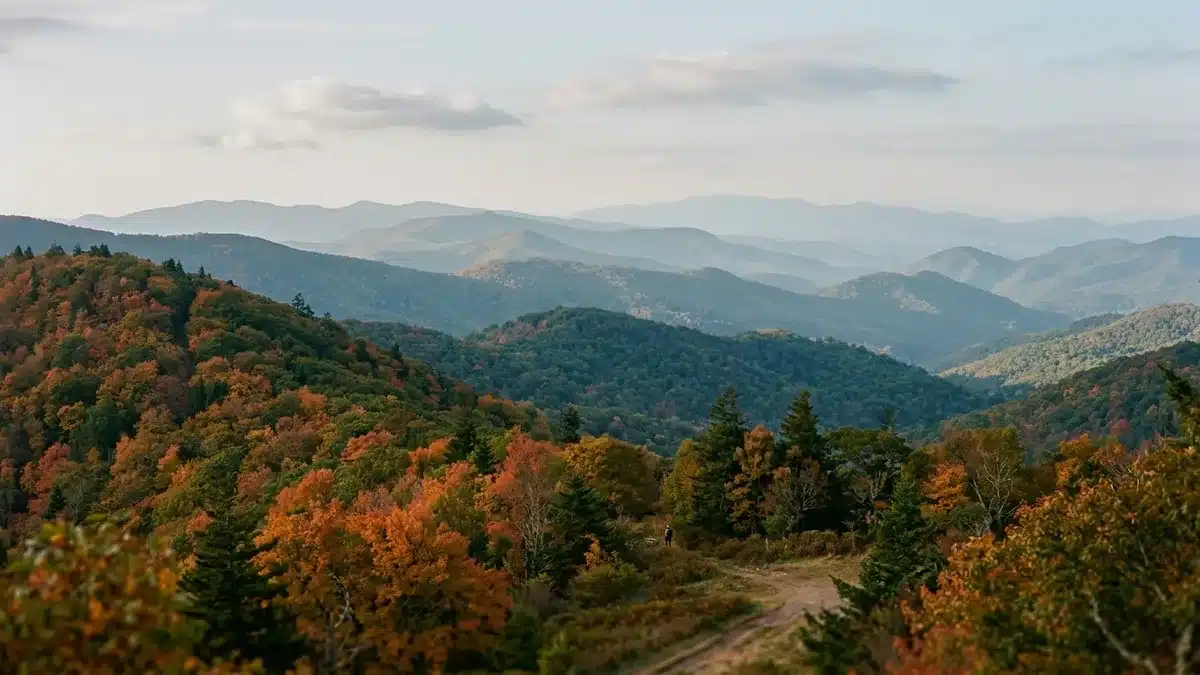
The Shenandoah Valley has a four-season mountain climate. It generally falls within Virginia Tourism’s Western Mountain region. January averages are roughly 27 to 45 degrees F, and July averages are roughly 65 to 87 degrees F. Ridgelines along Skyline Drive run cooler than the valley floor, so one day can span two seasons.
That vertical stretch matters for planning. Skyland, at mile 41.7, is the highest point on Skyline Drive at 3,680 feet, and the Valley floor sits far lower. A sunny afternoon in Front Royal can feel like spring while the overlooks above sit in chilly wind. Pack a layer even in warm months.
Spring in the Valley
Spring arrives as a slow ramp, with cool mornings and warm afternoons through April and May. Showers are common, and trails can stay muddy after a wet week. If you want waterfalls running full, spring is the time. For trail ideas that suit a casual pace, see our guide to hiking trails in Shenandoah National Park.
Summer in the Valley
Summer brings warm, humid days. An occasional afternoon thunderstorm rolls through. Start hikes early and save the afternoon for shade. Luray Caverns, roughly 55 minutes by car from Royal Oak Retreat, is an underground option that stays cool whatever the weather outside. Drive times are estimates and vary with traffic.
Fall in the Valley
Fall is the headline season. Color in the Western Mountain region typically peaks October 15-25, and weekends on Skyline Drive fill quickly. If crowds bother you, choose a weekday over a Saturday. A shorter, lower trail also beats a famous summit. Our seasonal guide to things to do in the Shenandoah Valley covers quieter alternatives.
Winter in the Valley
Winter is cold and quiet, with occasional snow. Skyline Drive can close during winter weather, so check the National Park Service page for Shenandoah National Park before you drive up. In-park Lewis Mountain Cabins run a 2026 season from April 10 through November 8, according to Delaware North, which makes valley cabins the practical winter base.
Does It Snow in Virginia, and Does the State Have Real Winters?
Yes, it snows in Virginia, and winter is a distinct season, though snowfall varies widely by region and by year. Mountain areas such as the Shenandoah Valley generally see more snow than Tidewater, where winter storms more often mean rain or ice. Slush is common there too. No single statewide snowfall number describes the whole state.
For a concrete local example, the National Park Service’s climate page for Manassas National Battlefield Park reports nearly 24 inches of average annual snowfall, with snowfalls of 4 inches or more occurring only twice per winter on average. The same page gives an annual precipitation range of 25-55 inches. These figures describe the Manassas area in Northern Virginia, not every county.
When does it snow? Typically between December and March, with January and February the coldest stretch. Snowfall varies greatly from one winter to the next, so one mild year says little about the next. For a Valley-specific outlook, check the National Weather Service forecast for the town nearest you.
Fairfax County notes that January can bring ice and snow storms, and ice is often the bigger travel problem. Steep driveways and mountain roads can turn slick fast. That is why Royal Oak Retreat requires a 4×4 vehicle in winter, due to its steep driveway and possible snow.
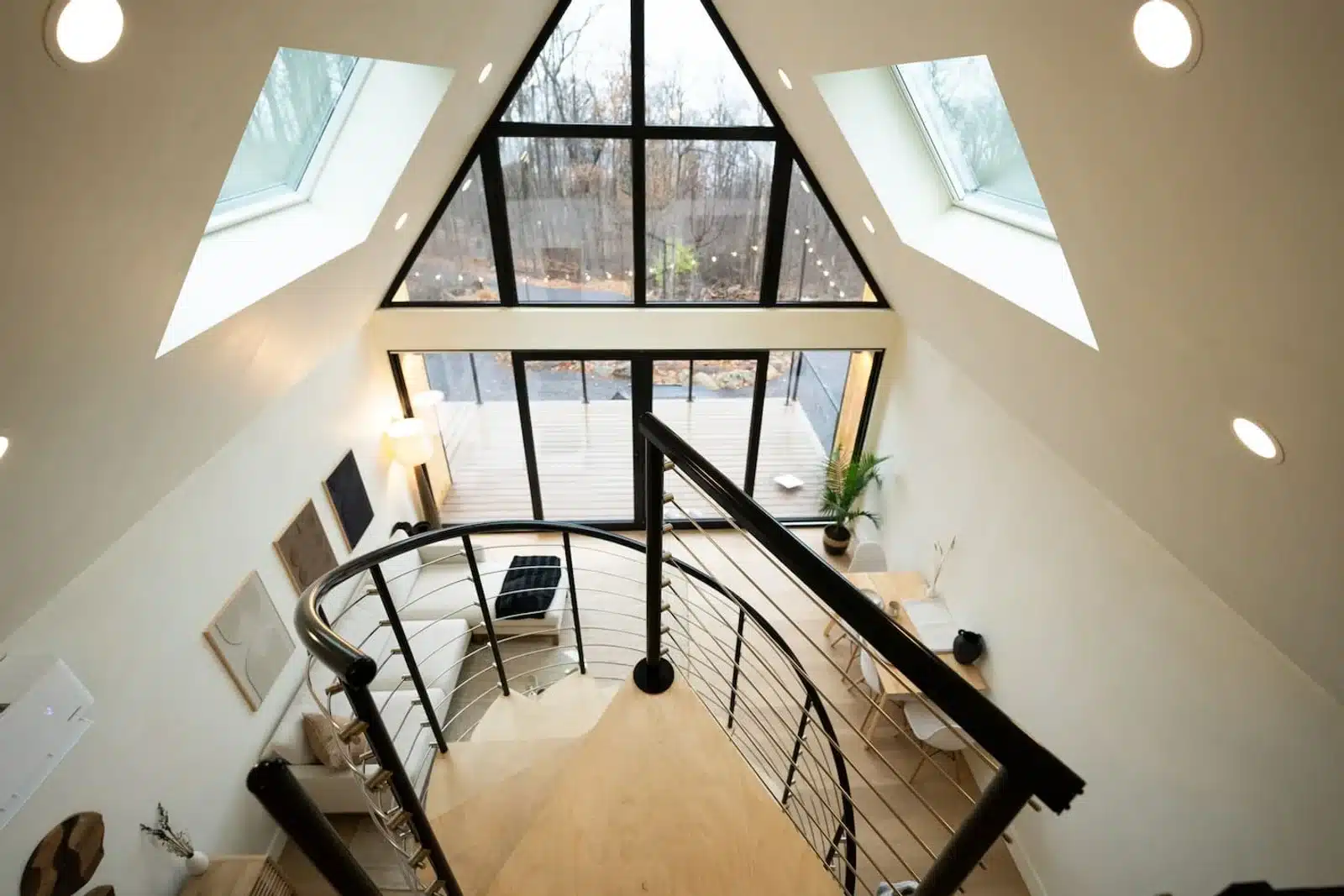
Winter is also when the wellness setup earns its keep. Royal Oak Retreat pairs a Scandinavian-style dry sauna with a cold plunge and a sunken hot tub on one deck, and the sauna runs on the property’s own power setup, so cold weather does not shut it down.
Is Virginia a Very Humid State?
Virginia is a humid state in summer, because its humid subtropical climate pulls warm, moist air from the South Atlantic and the Gulf of Mexico. Fairfax County says August humidity can feel unbearable, while Virginia Places describes January as typically cold and dry. Humidity is a summer story, not a year-round one.
The Virginia Tourism city table shows how hot July gets in the lowlands, with average July temperatures of 88 F for Washington, D.C. and Richmond, 87 F for Norfolk and Roanoke, and 86 F for Lynchburg. Humidity makes those numbers feel higher. Thunderstorms often build in the afternoon and clear by evening.
Mountains soften the effect. With air about 10 degrees F cooler on average, the Shenandoah Valley and Skyline Drive overlooks offer relief that Richmond or Norfolk cannot. Hike at sunrise, take the afternoon off, and plan on a cooler evening outdoors.
At a cabin with a cold plunge, a hot July afternoon has an obvious use. After sunset, the sunken hot tub at Royal Oak Retreat opens to the night sky, and the forest around the deck holds cooler air than most lowland towns do.
What Is the Weather Like in Virginia in November?
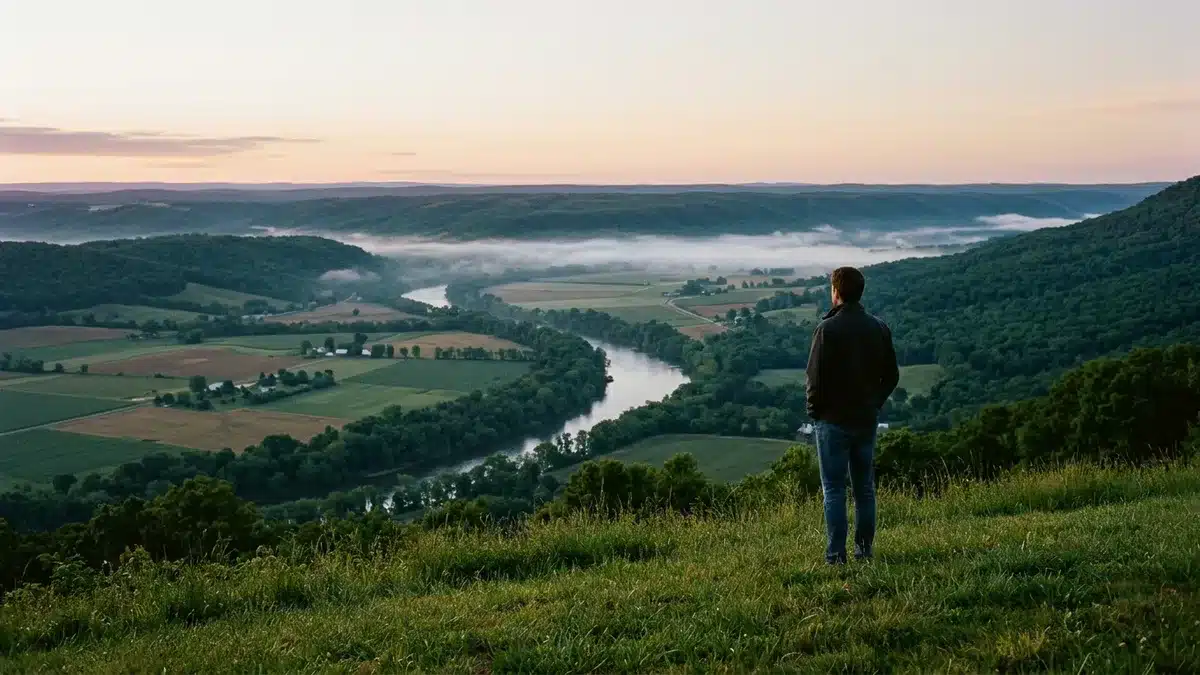
Virginia in November is late fall turning toward winter: cooler days, cold nights, and falling leaves, with the mountains cooling first. Mountain color typically peaks in mid to late October, so by November most leaves have dropped in the Valley, while the eastern Piedmont and Tidewater hold color a little longer.
For a baseline, Virginia Tourism lists average October temperatures of 68 to 71 F for Washington, D.C., Richmond, Norfolk, Lynchburg, and Roanoke. Expect November to run cooler than that, with frost on some mornings and the first light snow possible on higher ground. Dress in layers, and bring a warm hat for evenings outside.
November is a quiet month. October accounts for roughly 24% of Shenandoah National Park’s annual visitation, and traffic on Skyline Drive thins noticeably afterward. In-park Lewis Mountain Cabins close for the season on November 8 in 2026, so valley lodging becomes the main option.
This is a good month for slow weekends: a morning walk through bare woods, a tasting at Fox Meadow Winery in Linden, then a fire pit evening at the cabin. Fox Meadow is about 5 minutes from Royal Oak Retreat, and Crimson Lane Vineyards in Hume is about 8 minutes away. Both are approximate drive times.
What Are the Best Months to Visit the Shenandoah Valley?
The best months to visit the Shenandoah Valley are late April through May for green hillsides and October for peak foliage, with winter ideal for quiet sauna-and-soak weekends. The right month depends on whether you want scenery or solitude. Warm evenings outdoors are another draw.
Shenandoah National Park welcomed 1.7 million visitors in 2026, according to the National Park Service, and October carries roughly 24% of annual visitation. That concentration is why fall weekends feel busy. If color is your goal, accept the crowds or visit midweek.
- Late April to May: Greening woods, running streams, and moderate crowds. Pack a rain shell.
- June to August: Hot, humid lowlands and cooler ridgelines. Hike early and plan evenings outdoors.
- September to October: Lower humidity and foliage. Booking 6 to 8 weeks ahead is a reasonable rule of thumb for peak foliage weekends.
- December to February: Cold, quiet, and sometimes snowy. Check road conditions and bring a 4×4 vehicle for the cabin driveway.
For help choosing a base town, our blog post on where to stay in the Shenandoah Valley compares the area’s best towns and cabins, and our guide to cabins near Shenandoah National Park covers park access in more detail.
Which Season Suits a Stay at Royal Oak Retreat?
Royal Oak Retreat is an adults-first luxury wellness cabin in Shenandoah Farms, near Front Royal and Linden, with a sunken stargazing hot tub, a Scandinavian-style sauna, and a cold plunge on one private deck. It sleeps up to four guests, with a king bedroom and a queen loft, and has one bathroom.

Winter suits the contrast therapy island best: heat from the sauna, a short plunge in cold water, then a soak under a clear night sky. Many people use contrast therapy for relaxation. Anyone with a heart condition or circulatory concerns should check with a doctor first. The same goes for pregnancy. The cabin requires a 4×4 vehicle in winter, and the loft is reached by a spiral staircase, so guests who prefer to avoid stairs should use the main-floor bedroom.
Spring and fall pair the cabin with wine country. The cabin is about 40 minutes from Shenandoah National Park’s northern Front Royal entrance, and Luray Caverns is roughly 55 minutes away. Both distances are estimates that shift with traffic and weather. Skyline Drive conditions matter too. Summer rewards late evenings on the deck, and floor-to-ceiling windows keep the woods in view from every room.
Practical details: check-in is 3 PM and check-out is 11 AM. Starlink internet and an on-site EV charger are included, which helps if you are driving from Washington D.C., roughly an hour away. One dog under 50 lbs is welcome with a $100 pet fee. Celebrating something? The Romance Package adds an occasion-focused touch, and nearby experiences lists outings within an easy drive.
How Do You Plan a Trip Around Virginia’s Four Seasons?
Planning a trip around Virginia’s four seasons comes down to choosing a region, matching the season to your goal, and checking conditions before you drive. The steps below take most people under an hour and prevent the common mistake of packing for the statewide average.
- Pick your region first. Tidewater, the Piedmont, Northern Virginia, and the two mountain regions differ by 10 degrees F or more in some seasons, so choose the region before you check any forecast.
- Match the season to your goal. Choose October for foliage, May for waterfalls and green hills, summer mornings for early hikes, and winter for solitude and sauna time.
- Check the regional range, not a statewide average. Use the Virginia Tourism ranges above as a starting point, then confirm the National Weather Service forecast for your destination town.
- Pack in layers. Valley mornings, ridgeline overlooks, and warm afternoons can differ sharply on the same day, even in summer.
- Confirm road and access conditions. Check the National Park Service page for Skyline Drive status, and remember the cabin requires a 4×4 vehicle in winter because of its steep driveway.
- Book early for peak weekends. Allow 6 to 8 weeks for foliage weekends, and confirm pet details and loft access before you reserve.
Quick Reference: Virginia’s Seasons at a Glance
| Season | Best for | Watch for | Cabin note |
|---|---|---|---|
| Spring | Waterfalls, green hillsides, wineries | Rain and muddy trails | Fox Meadow Winery about 5 minutes away |
| Summer | Early hikes, caverns, starry evenings | Humidity and thunderstorms | Cold plunge and evening hot tub |
| Fall | Foliage and Skyline Drive | Weekend crowds | Book 6 to 8 weeks ahead |
| Winter | Quiet stays, sauna and soak | Ice and closures | 4×4 required for the driveway |
So, Does Virginia Have Four Seasons? The Short Answer
Virginia has four seasons, confirmed by the state’s own tourism authority and by local government sources, though its five climate regions mean each season looks different in the mountains than on the coast. The Shenandoah Valley delivers all four in full: green springs, humid summers, foliage that typically peaks October 15-25, and cold winters with snow on the ridges.
Choose the region first, then the season, then pack in layers. Through 2026 and beyond, the Valley rewards visitors who plan around conditions rather than the statewide average. For a private base in any season, browse our overview of cabin rentals in the Shenandoah Valley.

If this plan sounds like the kind of weekend you want, you can see availability and details for Royal Oak Retreat on the direct booking page. Whatever the season, the sauna, cold plunge, and sunken hot tub are waiting at the end of the day.
Frequently Asked Questions
Does it snow in Virginia?
Yes. Snow falls in every region in a typical winter, though the mountains and Northern Virginia see more than Tidewater, which often gets rain or mixed precipitation. The National Park Service reports nearly 24 inches of average annual snowfall at Manassas. That is a local example and not a statewide figure.
When does it snow in Virginia?
Snow typically falls between December and March. January and February are the coldest stretch. An early or late storm can happen outside that window, and totals vary greatly from year to year. Check the National Weather Service forecast before you travel.
How much snow does Virginia get, and is it a lot?
It depends on the region. At Manassas, snowfalls of 4 inches or more occur only twice per winter on average, which is modest. Mountain ridgelines generally see more, and no single statewide number describes the whole state.
Does Virginia have winters?
Yes. Winter is a distinct season, with cold snaps, ice, and snow storms in January according to Fairfax County. Tidewater winters run milder, while the mountain regions run colder, so pack for the specific region you are visiting.
What are the best months to visit the Shenandoah Valley?
Late April through May and October are the most popular for green hillsides and peak foliage. Summer suits early morning hikes, and winter suits quiet stays. October brings roughly 24% of Shenandoah National Park’s annual visitation, so book 6 to 8 weeks ahead for foliage weekends.
When is fall foliage at its peak in Virginia?
Virginia Tourism lists typical peaks of October 10-20 in the Southwestern Mountain region, October 15-25 in the Western Mountain, Northern Virginia, and western Piedmont regions, and October 20-31 in the eastern Piedmont and Tidewater. These are typical ranges, not guarantees. Rainfall and early frosts shift them.
Is Royal Oak Retreat usable in winter?
Yes. The sauna runs on the property’s own power setup, so it is not weather-dependent, and the cold plunge and sunken hot tub sit on the same deck. A 4×4 vehicle is required in winter because of the steep driveway, and check-in is at 3 PM.
How far is Royal Oak Retreat from Shenandoah National Park?
About 40 minutes to the park’s northern Front Royal entrance, and roughly 55 minutes to Luray Caverns. Washington D.C. is roughly an hour away. These are estimates, and traffic, weather, and Skyline Drive conditions vary.
Content powered by inkSTR.co