
A map of Shenandoah National Park campgrounds shows four developed frontcountry campgrounds strung along Skyline Drive from north to south: Mathews Arm at milepost 22.1, Big Meadows at milepost 51.2, Lewis Mountain at milepost 57.5, and Loft Mountain at milepost 79.5, plus the group-only Dundo Campground near milepost 83.7. Reading the official park map as a sequence of stops along the 105-mile drive, rather than a scattered list, is the fastest way to plan which campground fits your entrance point and itinerary.
Key Takeaways
- Shenandoah National Park has four frontcountry campgrounds arranged along Skyline Drive at mileposts 22.1 (Mathews Arm), 51.2 (Big Meadows), 57.5 (Lewis Mountain), and 79.5 (Loft Mountain), plus Dundo Campground for groups near mile 83.7.
- Big Meadows is reservation-only through Recreation.gov; standard sites run $30 per night, and group sites D163 and D167 run $75 per night for 7 to 15 people.
- Lewis Mountain is the park’s smallest campground and first-come, first-served only. Mathews Arm and Loft Mountain mix reservable and walk-up sites.
- Reservations open on a rolling six-month window at 10:00 a.m. Eastern time on Recreation.gov.
- Shenandoah National Park drew 1.7 million visitors in 2026, who spent $132 million in nearby communities, per the National Park Service; October alone accounts for roughly 24% of annual visitation.
- Dogs are allowed on 480 of the park’s 500 miles of trails, according to park concessionaire Delaware North, making several campgrounds workable bases for pet owners.
If you’ve pulled up the park brochure and found yourself squinting at four dots along a squiggly line, you’re not alone. The official campground maps are useful once you understand how they’re organized: geographically, north to south, tied to specific Skyline Drive mileposts rather than sorted by size or amenities. That’s the system we’re breaking down here for anyone planning a 2026 trip to Shenandoah National Park.
This guide walks through each of the four frontcountry campgrounds plus Dundo, in the order you’d actually encounter them driving Skyline Drive from the northern Front Royal entrance toward Rockfish Gap in the south. We’ll cover exact mileposts, what’s within walking distance of each site, reservation rules, and map-reading details that most park-planning articles skip, like which loops sit near generator-free zones or which campground map shows the closest waterfall.
We’re writing this from Shenandoah Farms, Virginia, about 40 minutes south of the park’s northern entrance, where guests routinely ask us which campground map actually makes sense before their trip. If camping isn’t your style this year but the forest still is, a private cabin with a hot tub might make more sense than a tent, and we’ll get to that too.
How Do You Read the Official Shenandoah National Park Campground Map?
The official Shenandoah National Park campground map is a set of downloadable PDFs organized by Skyline Drive milepost, each showing one campground’s internal layout: loops, individual sites, restrooms, and nearby trails. The National Park Service maps page lists these geographically from the park’s northern boundary near Front Royal down to Rockfish Gap in the south, matching the order you’d drive them.
Third-party resource NPMaps compiles 47 free Shenandoah maps in total, including the general park brochure and individual campground PDFs. The Mathews Arm map shows the campground alongside viewpoints and picnic areas near Elkwallow; the Big Meadows map layers in the lodge, visitor center, and Appalachian Trail crossing; the Lewis Mountain map adds the small cabin area and camp store; and the Loft Mountain map covers its overlooks and Skyline Drive access points.
Use the NPS page as your starting point, then download the specific campground PDF for your chosen site. Each PDF includes reservation-status color coding on the site grid, so you can tell at a glance which loops are bookable in advance versus first-come, first-served.
What Are the Shenandoah Campgrounds, North to South?
Shenandoah National Park’s developed campgrounds run in a fixed geographic sequence along Skyline Drive: Mathews Arm at mile 22.1, Big Meadows at mile 51.2, Lewis Mountain at mile 57.5, and Loft Mountain at mile 79.5, with Dundo Group Campground near mile 83.7. Each sits in a different park district with distinct terrain, from northern hardwood ridges to the high meadow at Big Meadows to the summit plateau at Loft Mountain.
Mathews Arm Campground, Milepost 22.1
Mathews Arm is the first campground you’ll reach entering from the north, sitting next to a nature trail and the trailhead for Overall Run Falls, which the National Park Service identifies as the tallest waterfall in the park. Elkwallow Wayside, which sells camping supplies and basic food, is 2 miles away. Mathews Arm holds approximately 165 individual sites with a mix of reservable and first-come, first-served options. No electric or water hookups are available at individual sites, and trailer sites share the same restroom and picnic infrastructure as tent sites.
Big Meadows Campground, Milepost 51.2
Big Meadows sits near the park’s central hub of services, with Byrd Visitor Center roughly a mile away and Dickey Ridge Visitor Center back at mile 4.6. Three waterfalls are within walking distance, and the open meadow itself draws deer and wildflower viewers throughout the season. Big Meadows is Shenandoah’s largest reservation-only campground for individual sites, holding around 221 sites, and every reservation must go through Recreation.gov. The official Big Meadows campground PDF lists standard sites at $30 per night, with group sites D163 and D167 priced at $75 per night for parties of 7 to 15 people.
Lewis Mountain Campground, Milepost 57.5
Lewis Mountain is the smallest campground in Shenandoah National Park, with around 30 sites, and it’s the only one of the four that runs strictly first-come, first-served, meaning no advance Recreation.gov booking. It also includes a small cabin area and access point to the Appalachian Trail. Because it can’t be reserved ahead, arriving by early afternoon on Fridays during peak fall weekends is the practical way to secure a spot.
Loft Mountain Campground, Milepost 79.5
Loft Mountain is the largest campground in the park, sitting atop Big Flat Mountain with views stretching east across the Piedmont and west across the Shenandoah Valley. Its site count runs roughly 207, mixing reservable and first-come sites. Trail access into the Big Run Wilderness area sits nearby, along with an amphitheater, camp store, and laundry facilities that make it the most self-sufficient of the four.
Dundo Campground, Milepost 83.7
Dundo is a small, group-only campground near the park’s southern end, where the Appalachian Trail passes directly through the property. Every site includes a fire ring and picnic table. Dundo doesn’t accept individual reservations; it’s built for organized groups only. Visit Shenandoah’s campground directory lists it separately from the four frontcountry campgrounds for exactly that reason.
Which Campground Is Considered the Best in Shenandoah National Park?
There’s no single best campground in Shenandoah National Park; the right choice depends on what you want from the trip. Big Meadows offers the most services and waterfall access within a short walk. Loft Mountain has the best long-range views and quietest atmosphere. Mathews Arm puts you closest to the park’s tallest waterfall, and Lewis Mountain suits campers who want a smaller, less-trafficked site and don’t mind arriving without a reservation.
If this is your first Shenandoah trip, Big Meadows is the practical pick. It’s reservation-only, so you’re not gambling on a first-come site, and it sits within walking distance of Byrd Visitor Center, a camp store, and three waterfalls. The trade-off is that Big Meadows is also the most heavily booked campground during October, so weekend reservations for peak leaf season typically need to be made the moment the six-month Recreation.gov window opens.
For a quieter, more scenic stay, Loft Mountain’s elevation and dual-direction views make it the standout, and its larger size, around 207 sites, means it’s statistically less likely to sell out completely compared to the smaller Lewis Mountain.
Which Is Better, Skyland or Big Meadows Lodge?
Skyland and Big Meadows Lodge are both in-park lodging options operated by Delaware North, distinct from the four camping-only campgrounds covered above, and the better choice depends on elevation preference and proximity to services. Skyland sits at mile 41.7, the highest elevation lodging in the park, known for sunset views over the valley. Big Meadows Lodge sits at mile 51.2 next to Big Meadows Campground, putting it closer to the visitor center, dining, and waterfall trailheads.
If a full lodge experience with a restaurant and taproom on site matters more than elevation, Big Meadows Lodge is the more convenient base, since it sits inside the same developed hub as the campground, visitor center, and trail network. If sunset views and a slightly more remote feel matter more, Skyland wins on elevation alone. Neither is a campground in the tent-and-fire-ring sense; both book through Delaware North, the park’s official lodging concessionaire, rather than Recreation.gov’s camping system.
Which Section of Shenandoah National Park Is Best?
Shenandoah National Park is divided into three sections along Skyline Drive: the North District (roughly miles 0 to 32), the Central District (miles 32 to 65), and the South District (miles 65 to 105), and each favors a different kind of trip. The North District, home to Mathews Arm, has the least crowded overlooks and the steepest, quieter trails. The Central District, containing Big Meadows and Lewis Mountain, has the highest concentration of services and waterfalls, plus the busiest traffic. The South District, home to Loft Mountain and Dundo, has the longest sightlines and the fewest crowds outside of peak fall weekends.
For a base camp near Front Royal and the northern entrance, the North District keeps drive times shortest. Guests staying in Shenandoah Farms or Front Royal, roughly 40 minutes from Skyline Drive’s northern entrance, are well positioned to reach Mathews Arm and the North District overlooks without the Central District’s weekend backups near Big Meadows. If you’d rather use a private cabin as home base instead of camping, our guide to cabin rentals in Shenandoah Valley, Virginia breaks down which towns put you closest to each district.

Can You Show Me a Map of Skyline Drive and Shenandoah National Park?
Skyline Drive is the 105-mile scenic road running the full north-to-south length of Shenandoah National Park, connecting Front Royal in the north to Rockfish Gap and Interstate 64 in the south, with all four frontcountry campgrounds accessible directly from it. The road includes 75 numbered overlooks, and every campground, visitor center, and wayside is referenced by its milepost along this single route.
Using the map effectively means thinking in mileposts rather than town names. Entering from Front Royal puts you at milepost 0; Mathews Arm at mile 22.1 is roughly a 30 to 40 minute drive south. Continuing to Big Meadows at mile 51.2 adds close to another hour depending on overlook stops, since Skyline Drive’s 35 mph limit and frequent curves make actual drive times longer than the mileage alone suggests. Download the full official park map and the backcountry web map for off-trail camping from the Shenandoah National Park campground maps page before you go; cell signal drops out often once you’re past the northern entrance.
The backcountry web map, referenced in NPS’s Backcountry Trip Planning resources, is a separate document from the frontcountry campground maps. Backcountry camping requires its own permit and zone planning and isn’t interchangeable with reserving a site at Mathews Arm, Big Meadows, Lewis Mountain, or Loft Mountain.
How Do Reservations and First-Come Sites Actually Work?
Shenandoah campground reservations run through Recreation.gov, which opens bookings on a rolling six-month window starting at 10:00 a.m. Eastern time. Big Meadows is reservation-only for individual sites. Mathews Arm and Loft Mountain mix reservable and first-come, first-served sites within the same campground, and Lewis Mountain is first-come, first-served exclusively.
In practice, that means if you have a fixed October weekend in mind for Big Meadows, you need to be logged into Recreation.gov exactly six months out, ready to book the moment the window opens, since fall weekend sites there routinely fill within hours. For Mathews Arm or Loft Mountain, check which loops are marked reservable versus first-come on the individual campground PDF before you go; that tells you whether you need to book ahead or just arrive early. Lewis Mountain offers no such safety net: showing up Friday afternoon during leaf season is a gamble, and arriving by midday is the safer play.
Generator rules differ by campground and even by loop. At Big Meadows, generator-free sites prohibit them entirely, while other zones allow generator use from 8:00 to 10:00 a.m. and 4:00 to 7:00 p.m., with extended cold-weather windows during shoulder-season periods as noted on the official map. If quiet mornings matter to you, request a generator-free loop when booking.
What Do the Fees, Seasons, and Amenities Actually Look Like?
Shenandoah’s four frontcountry campgrounds share similar baseline pricing but differ in amenities and size. The table below consolidates the verified figures from the official Big Meadows campground PDF, since fee and site-count data has varied across older third-party pages.
| Campground | Milepost | Approx. Sites | Reservation Type | Notable Nearby Feature |
|---|---|---|---|---|
| Mathews Arm | 22.1 | ~165 | Mixed (reservable + first-come) | Overall Run Falls, Elkwallow Wayside (2 mi) |
| Big Meadows | 51.2 | ~221 | Reservation-only ($30/night standard; $75/night group sites D163, D167) | Byrd Visitor Center (~1 mi), three waterfalls |
| Lewis Mountain | 57.5 | ~30 | First-come, first-served only | Appalachian Trail access, camp store |
| Loft Mountain | 79.5 | ~207 | Mixed (reservable + first-come) | Big Run Wilderness trails, two waterfalls |
| Dundo (group only) | ~83.7 | Group sites only | Group reservation required | Appalachian Trail passes through site |
All developed campgrounds operate seasonally, typically opening in early spring and closing in late fall, according to the official NPS campground page, so confirm exact opening and closing dates for your travel year before booking. Big Meadows enforces an 11 a.m. checkout and a 30-night annual stay limit, with quiet hours from 10 p.m. to 6 a.m. The park’s emergency contact number listed on the Big Meadows map is 1-800-732-0911, and the general park information line is 540-999-3500; save both before you lose signal on Skyline Drive.
What About Camping Near Shenandoah River State Park?
Shenandoah River State Park, officially the Raymond R. “Andy” Guest Jr. Shenandoah River State Park, offers a separate camping option along the river outside the national park’s boundary, distinct from the four Skyline Drive campgrounds covered above. It’s a useful alternative for travelers who want river access and lower elevation camping without the six-month reservation scramble that Big Meadows can require during fall.
For visitors weighing river camping against a private cabin stay, the practical difference comes down to amenities and privacy. A state park campsite gets you proximity to the water and trail network at a lower nightly cost; a private cabin trades that for a private bathroom and kitchen, with no shared bathhouse line at 7 a.m. Outfitters like Shenandoah River Outfitters service this stretch of river for tubing and paddling trips if you’re staying nearby either way.
What Should You Prioritize When Choosing a Campground?
Choosing the right Shenandoah campground comes down to four practical factors: entrance proximity, reservation flexibility, on-site services, and trail access. Weigh these against your actual itinerary rather than picking based on size or name recognition alone.
- Match the campground to your entrance point. If you’re driving from Washington D.C. or the Front Royal area, Mathews Arm at mile 22.1 minimizes drive time compared to pushing further south to Loft Mountain.
- Decide how much reservation risk you can accept. If your dates are fixed and non-negotiable, book Big Meadows the moment the Recreation.gov window opens. If you’re flexible, Lewis Mountain’s first-come system rewards early arrival instead of early booking.
- Check what’s within walking distance. Big Meadows wins for waterfall access and visitor services; Loft Mountain wins for views and self-sufficiency with its camp store and amphitheater.
- Confirm pet and generator policies before you go. With dogs allowed on 480 of the park’s 500 miles of trails, per Delaware North, most campgrounds work for pet owners, but individual loop rules on quiet hours and generators vary.
- Avoid underestimating drive time. Skyline Drive’s 35 mph limit and curves mean the distance between Mathews Arm and Loft Mountain, roughly 57 miles, can take close to two hours with stops.

What If You’d Rather Skip the Tent Altogether?
Not every Shenandoah trip needs a sleeping bag and a shared bathhouse. If you’ve spent an afternoon studying the campground map and decided that first-come lines, generator schedules, and 6 a.m. quiet-hour enforcement aren’t your idea of a weekend off, a private cabin nearby solves the same location problem without the logistics.
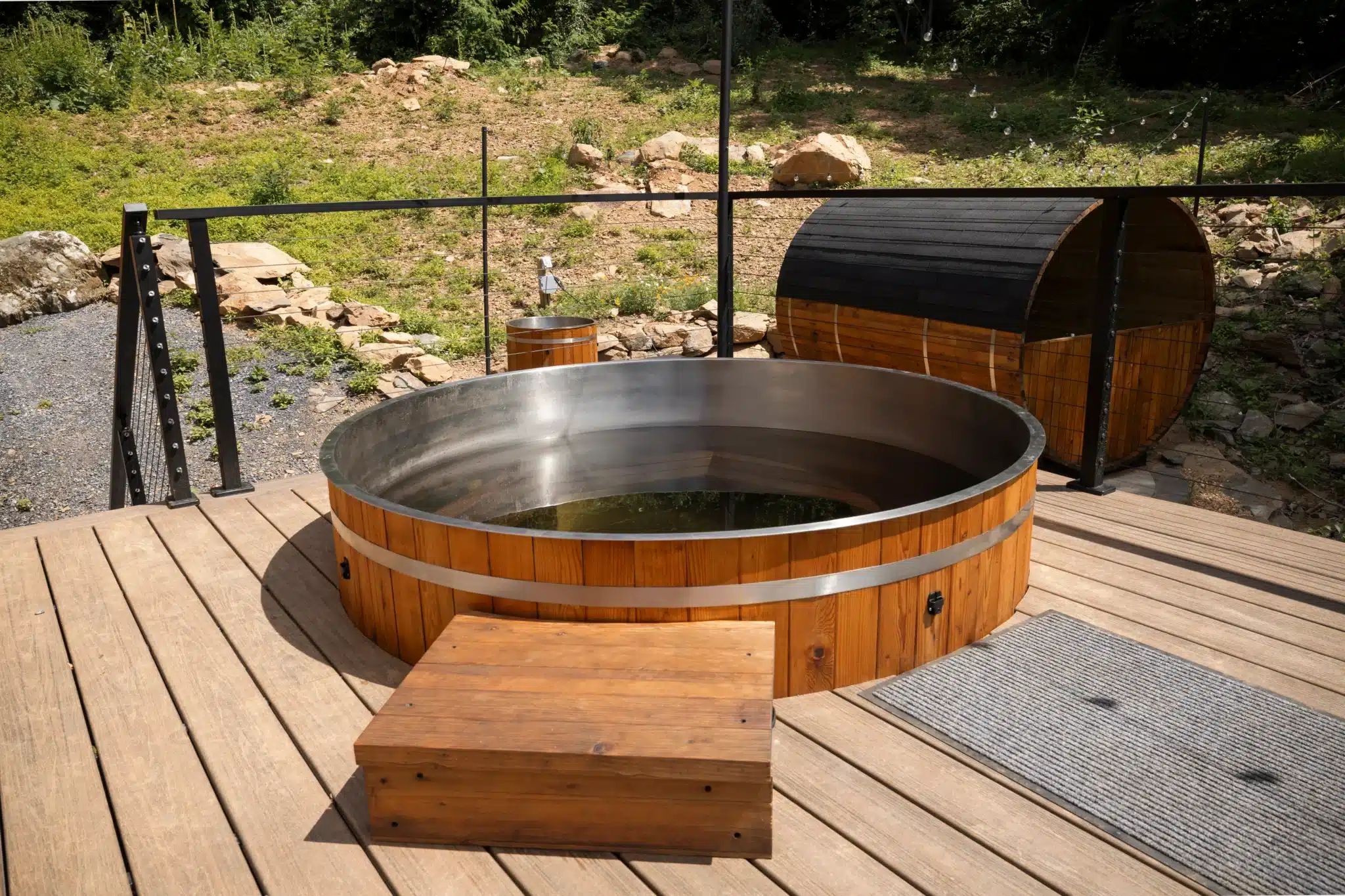
Royal Oak Retreat sits in Shenandoah Farms, about 40 minutes from the park’s Skyline Drive and northern entrance corridor near Mathews Arm and Front Royal. It’s a 1,000-square-foot, adults-first cabin with a king bedroom and a queen loft reached by a spiral staircase, sleeping up to four. Instead of a picnic table and fire ring, the property has a sunken outdoor hot tub built for stargazing, a Scandinavian-style sauna, and a cold plunge forming a contrast-therapy setup on the deck.
The cabin is built with no plastics or off-gassing chemicals in its construction, and it comes with Starlink internet and an on-site EV charger, details that matter if you’re road-tripping from the DMV and want reliable connectivity once you’re off the grid. It’s pet-friendly for one dog under 50 lbs with a $100 pet fee, which covers the same trail access that draws campers to Shenandoah in the first place. Guests planning a Skyline Drive day trip from here can review our hiking trails in Shenandoah National Park guide for routes near the northern entrance.
For travelers debating between a Recreation.gov gamble and a guaranteed private stay, checking availability at Royal Oak Retreat avoids the six-month booking window entirely. It’s also worth comparing against nearby options in our guide to the best cabins near Shenandoah National Park if you want a broader view of the area’s private rental market before deciding.
What Else Is Worth Building Into Your Shenandoah Trip?
Beyond the campgrounds themselves, a few nearby stops round out a Shenandoah trip without adding much drive time. Luray Caverns, about 20 to 25 minutes from the park’s Thornton Gap entrance, makes a good rainy-day alternative to hiking if weather turns. Wine tastings at Fox Meadow Winery in Linden, roughly 5 minutes from Shenandoah Farms, or Crimson Lane Vineyards in Hume, about 8 minutes away, pair naturally with a day spent off Skyline Drive.
For groups planning a longer stay that mixes park time with local flavor, our seasonal guide to things to do in Shenandoah Valley covers month-by-month options, and Nearby Experiences lists curated add-ons if you’d rather not plan every stop yourself. Fall remains the busiest window regardless of where you stay; October alone draws roughly 24% of the park’s annual visitors, per NPS data, so weekday visits in late September or early November offer a real crowd-avoidance advantage over Columbus Day weekend.
Frequently Asked Questions
Are there any vacation rentals available in Shenandoah National Park, Virginia?
Private vacation rentals sit outside the park’s boundary rather than inside it, since Shenandoah National Park’s only in-park lodging comes through Delaware North’s Skyland, Big Meadows Lodge, and Lewis Mountain Cabins, or the National Park Service campgrounds. Just outside the park, towns like Front Royal, Luray, and Shenandoah Farms have private cabin rentals, including Royal Oak Retreat, about 40 minutes from Skyline Drive’s northern section.
How long is Skyline Drive in Shenandoah National Park?
Skyline Drive runs 105 miles from Front Royal in the north to Rockfish Gap in the south, following the ridgeline of the Blue Ridge Mountains for the entire length of the park. The speed limit is 35 mph throughout, so driving the full length with overlook stops typically takes a full day rather than a couple of hours.
Where should you stay near Shenandoah National Park?
Where you stay near Shenandoah National Park depends on which section of Skyline Drive you plan to spend the most time in. Front Royal and Shenandoah Farms suit the North District near Mathews Arm; Luray and Stanley suit the Central District near Big Meadows and Lewis Mountain; and Waynesboro suits the South District near Loft Mountain. Options range from the four frontcountry campgrounds and in-park lodges to private cabin rentals in surrounding towns.
Where should you stay in the Shenandoah Valley if you’re not camping?
Non-camping travelers in the Shenandoah Valley typically choose between in-park lodges like Skyland or Big Meadows Lodge, or private cabin rentals in nearby towns like Front Royal, Luray, and Shenandoah Farms. Private cabins generally offer more privacy and full kitchens, while in-park lodges put you closest to trailheads without a drive back to Skyline Drive each morning.
Which campground is closest to the northern entrance near Front Royal?
Mathews Arm Campground, at Skyline Drive milepost 22.1, is the closest developed campground to the park’s northern entrance near Front Royal, roughly a 30 to 40 minute drive south along Skyline Drive from the entrance station.
Do you need a reservation for every Shenandoah campground?
No. Big Meadows requires a reservation through Recreation.gov for every individual site, but Mathews Arm and Loft Mountain offer a mix of reservable and first-come, first-served sites, and Lewis Mountain is first-come, first-served exclusively with no advance booking option.
Are dogs allowed at Shenandoah National Park campgrounds?
Yes. Dogs are permitted at all four frontcountry campgrounds and on 480 of the park’s 500 miles of trails, according to park concessionaire Delaware North. A small number of trails, including sections requiring rock scrambling, restrict pets, so check specific trail rules before hiking with a dog from your campsite.
Final Thoughts on Planning Your Shenandoah Campground Map
A map of Shenandoah National Park campgrounds only makes sense once you read it the way the park is built: north to south, milepost by milepost, from Mathews Arm at mile 22.1 down to Dundo near mile 83.7. Big Meadows remains the easiest reservation-only option for first-time visitors, Lewis Mountain rewards early arrivals willing to skip advance booking, and Loft Mountain offers the best views for travelers who don’t mind driving the furthest south.
Whichever campground you choose for 2026, download the specific campground PDF before you lose signal on Skyline Drive, confirm your reservation window on Recreation.gov six months out if you’re set on Big Meadows, and build in a day for Luray Caverns or a nearby winery if weather doesn’t cooperate. And if a week of planning generator schedules and quiet hours sounds like more work than rest, a private cabin just outside the park boundary solves the same location problem without the site map at all.
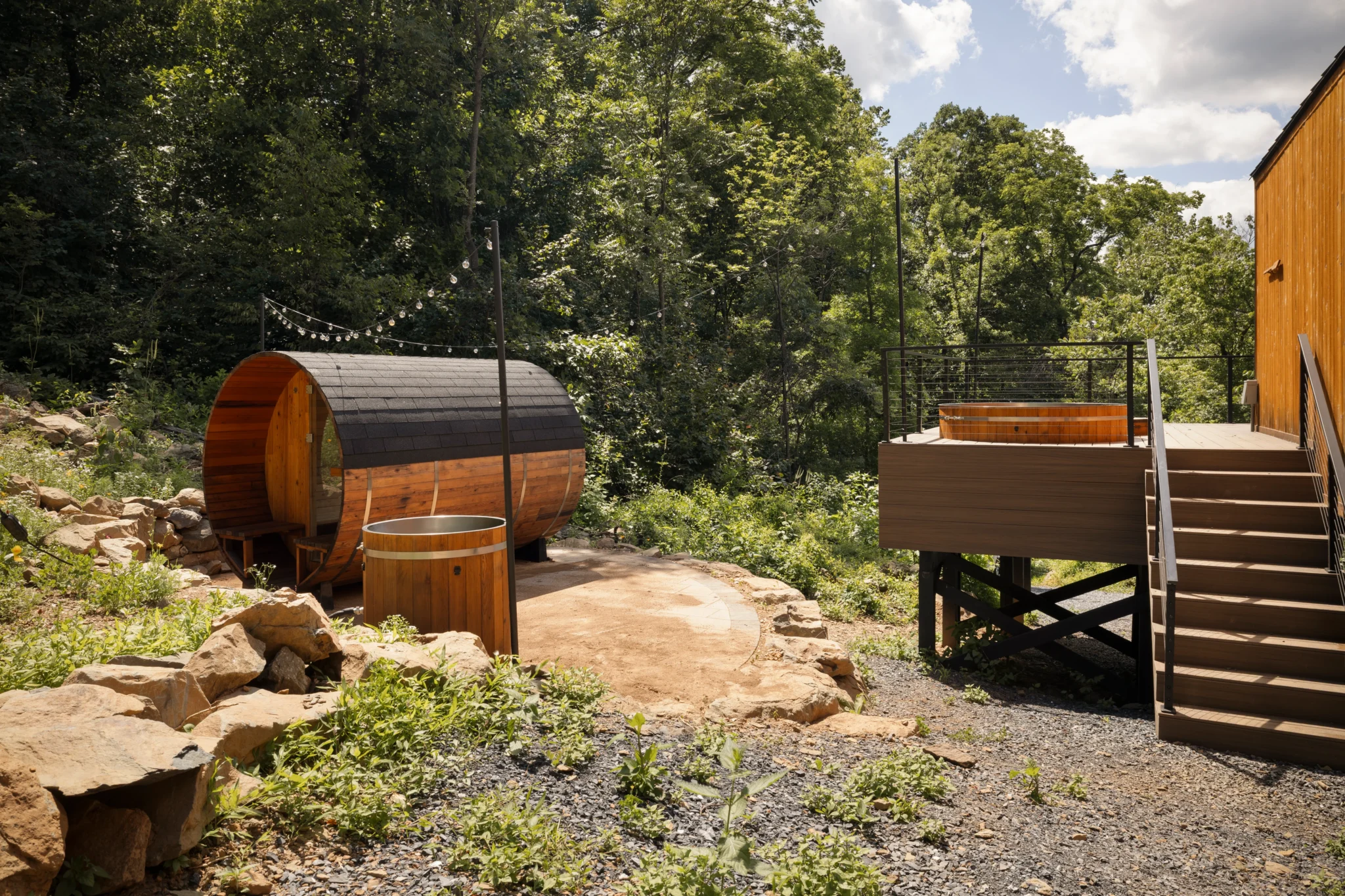
If you’ve mapped out your Shenandoah campground options and decided you’d rather trade the tent for a private deck, Royal Oak Retreat sits about 40 minutes from Skyline Drive’s northern entrance, with a hot tub, sauna, and cold plunge waiting after a day on the trail. Check availability here.
Content powered by inkSTR.co