
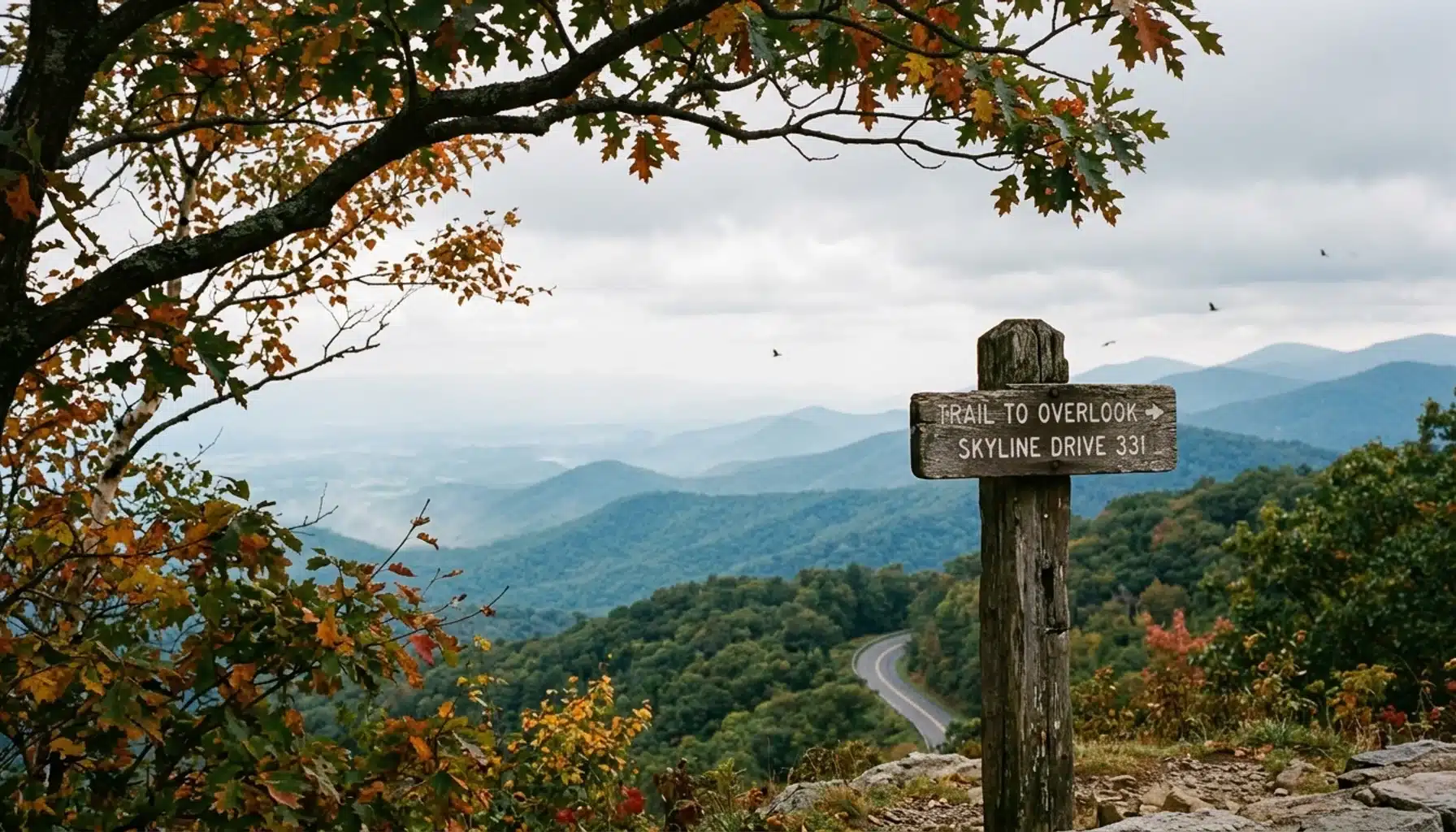
The Central District of Shenandoah National Park, running roughly from mile 31 to mile 65 along Skyline Drive, is the best part of the park for most visitors. It holds the highest peak, the densest cluster of overlooks, and the most reliable trail access of the park’s three districts.
Key Takeaways
- The Central District, between Thornton Gap (US 211) and Swift Run Gap (US 33), contains the highest concentration of standout overlooks and the park’s highest point, Hawksbill Summit at 4,051 feet.
- Skyline Drive runs 105 miles with a 35 mph speed limit; most visitors need 3 to 4 hours to drive it end to end with a few stops.
- Shenandoah National Park welcomed 1.7 million visitors in 2026, who spent $132 million in surrounding communities, according to the National Park Service.
- The North District (Front Royal to Thornton Gap) rewards scenic driving; the South District is the longest and quietest, with fewer developed facilities and more wilderness feel.
- Big Meadows and Skyland Lodge, both inside the Central District, make basecamping simple if you want to minimize drive time between hikes.
- Cabins in Shenandoah Farms near Front Royal, about 40 minutes from the park’s northern entrance, put you within easy reach of both the North and Central Districts without paying in-park lodging rates.
If you’ve spent any time scrolling forums or half-finished blog posts trying to figure out which part of Shenandoah is the best, you already know the park doesn’t give you one easy answer. It’s split into three distinct districts, North, Central, and South, and each one has a genuinely different personality. Some visitors want big-view driving loops. Others want a quiet trail with nobody on it.
At Royal Oak Retreat, we’ve fielded this exact question from hundreds of guests staying in Shenandoah Farms before they head into the park for the day. The honest answer depends on how much time you have and what you’re after, but if you’re picking one district to prioritize in 2026, it’s Central. Below, we’ll break down why, what the North and South Districts do better, and how to plan around whichever one you choose.
This guide also covers a few things most park write-ups skip entirely: what cell service looks like by district, which sections are actually manageable with young kids on foot, and where the value gap in lodging and parking really shows up. Those are the details that change an itinerary, not just decorate it.
Which Part of Shenandoah National Park Is the Best Overall?
The Central District is the best overall section of Shenandoah National Park because it packs the highest elevation, the most scenic overlooks, and the widest range of trail difficulties into a single, drivable stretch. Spanning mile 31 to mile 65 of Skyline Drive, between the Thornton Gap entrance (US 211) and the Swift Run Gap entrance (US 33), this district holds more land mass than the North or South sections combined with the park’s developed facilities.
Specifically, the Central District contains two lodges, Skyland Lodge and Big Meadows Lodge, two campgrounds, and two visitor centers, plus historic CCC-era cabins. As a result, it’s often called the section with the most superlatives: highest peak, highest point on Skyline Drive, and the highest density of pull-offs worth stopping for.
For first-time visitors with only one day, this is the section to prioritize. You’ll get Hawksbill Summit, Big Meadows, and several of the park’s most photographed overlooks without backtracking. Guests based at cabins near Shenandoah Valley National Park often use the Central District as their single-day itinerary anchor before branching into the North on a second visit.
What Is the Most Beautiful Part of Shenandoah National Park?
The Big Meadows area, located inside the Central District around mile 51, is widely considered the most beautiful part of Shenandoah National Park. This open meadow, framed by the Blue Ridge on both sides, offers a rare unobstructed view in a park otherwise defined by forest canopy, and it sits within walking distance of a visitor center, lodge, and trailhead.
Hawksbill Summit, also in the Central District, is the park’s highest peak at 4,051 feet. It offers multiple marked routes to the top and a small shelter structure at the summit, making it one of the more rewarding short hikes for the elevation gain. On a clear day, the 360-degree view stretches into the Shenandoah Valley on one side and the Piedmont on the other.
Two overlooks deserve specific mention beyond the Central District. Range View Overlook in the North District is one of the strongest viewpoints for that section, particularly in early morning light. South River Overlook in the South District is frequently cited as one of the park’s best sunrise spots, with far fewer cars competing for the pull-off than you’ll find at Central District overlooks by mid-morning.
Honest caveat: Big Meadows draws crowds fast on weekends between May and October. If you want the meadow without the parking lot scramble, arrive before 9 a.m. or after 5 p.m.
How Do the North, Central, and South Districts Compare?
Shenandoah National Park divides into three districts along its 105-mile Skyline Drive: North (Front Royal to Thornton Gap), Central (Thornton Gap to Swift Run Gap), and South (Swift Run Gap to Rockfish Gap). Each district has a distinct character, and the table below breaks down how they compare on scenery, crowd levels, and facilities as of 2026.
| District | Mile Markers | Best For | Crowd Level | Key Stops |
|---|---|---|---|---|
| North | 0 to 31 | Scenic driving, easy access from Front Royal | Moderate | Range View Overlook, Dickey Ridge Visitor Center |
| Central | 31 to 65 | Iconic hikes, highest elevation, lodging | Highest | Hawksbill Summit, Big Meadows, Skyland Lodge |
| South | 65 to 105 | Solitude, wilderness feel, longer drives between stops | Lowest | South River Overlook, Loft Mountain Campground |
Notably, the South District is the longest of the three but has the fewest developed facilities, which is exactly why it’s the quietest. If your priority is avoiding other hikers entirely, that’s the trade-off: more driving time between stops, less infrastructure, but genuine wilderness immersion. The North District, by contrast, rewards travelers who want strong views without committing to a full-day hike, since much of its appeal comes from the drive itself between Front Royal and Thornton Gap.
What Is the Best Town to Stay In When Visiting Shenandoah?
Front Royal is generally the best base town for visiting Shenandoah National Park because it sits at the park’s northern entrance, giving direct access to both the North and Central Districts without a long drive to reach Skyline Drive. Front Royal also connects easily to Shenandoah Valley wineries and to Washington D.C., roughly a 75 to 90 minute drive for weekend travelers.
For lodging, in-park options include Skyland Lodge at mile 41.7, Big Meadows Lodge, and rustic Lewis Mountain Cabins, all operated through the Delaware North concession per the official NPS lodging page. Budget-focused hikers can also look at the Potomac Appalachian Trail Club’s primitive backcountry cabins, a rustic alternative maintained by the club that also handles much of the park’s trail work.
Outside the park, Front Royal and the surrounding Shenandoah Farms area offer a different value proposition: you skip the park’s lodging premium and gain access to wineries like Fox Meadow Winery, five minutes from Shenandoah Farms, and Crimson Lane Vineyards in Hume, about eight minutes out. According to a Virginia Tourism Corporation short-term rental report, Shenandoah Valley rentals averaged a $95.62 daily rate at 45.7% occupancy, though premium cabins with wellness amenities command considerably more, with AirDNA reporting average daily rates near $323 in May 2026 for top-tier properties in the region.
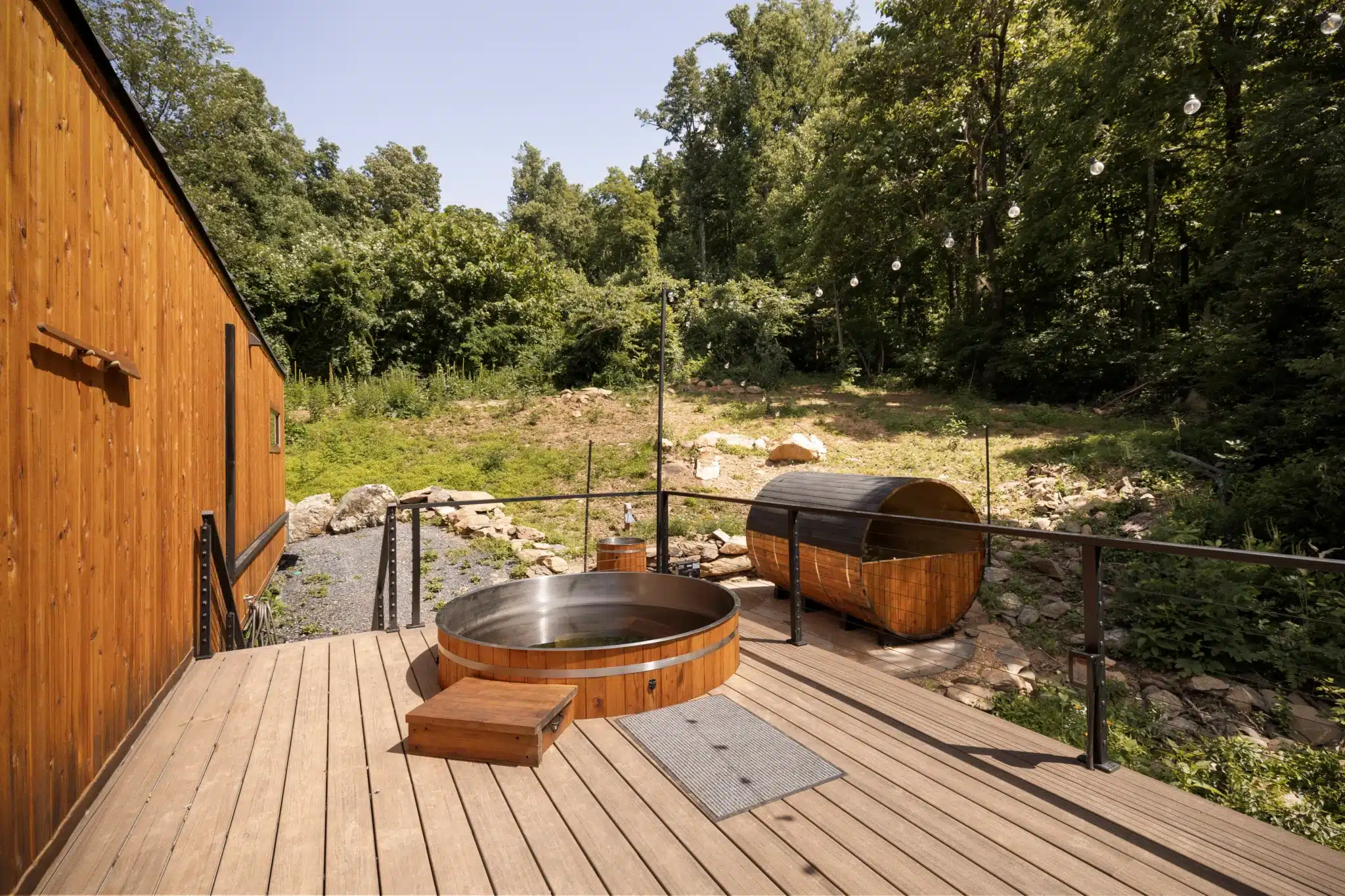
This is where Royal Oak Retreat fits into the picture. Set in Shenandoah Farms, about 40 minutes from the park, this adults-first cabin sleeps up to four across a main bedroom and a loft reached by spiral staircase. It’s built around a contrast-therapy island, sunken stargazing hot tub, Scandinavian sauna, and cold plunge, so after a full day on the Central District’s trails, you’re not driving back to a generic hotel room. You’re soaking under actual dark sky while the muscles recover.
Is Skyline Drive or the Blue Ridge Parkway Better for a Shenandoah Trip?
Skyline Drive is the better choice if your trip is centered specifically on Shenandoah National Park, since it’s the only road running through the park itself, while the Blue Ridge Parkway continues south from Rockfish Gap into a separate, much longer scenic corridor toward North Carolina. Skyline Drive is 105 miles long with a strict 35 mph speed limit, and most visitors report needing 3 to 4 hours to drive the full length with a handful of overlook stops.
The Blue Ridge Parkway picks up where Skyline Drive ends, at Rockfish Gap near mile 105, and stretches roughly 469 miles toward the Great Smoky Mountains. For a weekend trip focused on the park itself, driving all of Skyline Drive gets you every district’s overlooks in a single day. For a longer multi-day road trip, combining a partial Skyline Drive run with a stretch of the Parkway makes sense, but it’s a different kind of trip entirely.
Our own take on this question goes deeper in Is It Worth Driving All of Skyline Drive? A Straight Answer, which breaks down whether the full 105 miles is worth the time commitment versus focusing on just the Central District.
How Many Days Do You Need at Shenandoah National Park?
Two full days is the minimum recommended stay at Shenandoah National Park if you want to properly experience the Central District’s hikes plus a scenic drive through one additional district. One day is enough to drive the Central District and summit Hawksbill, but it doesn’t leave room for a longer trail or a second district.
For a two-day itinerary, spend day one entirely in the Central District: drive from Thornton Gap to Swift Run Gap, stopping at Big Meadows and hiking Hawksbill Summit. Reserve day two for either the North District’s overlooks near Front Royal or the South District’s quieter trails around Loft Mountain campground.
A three-to-four-day trip lets you drive the entire 105-mile length of Skyline Drive at a relaxed pace, hike a longer route like a section of the Appalachian Trail, and still have an evening free to visit Luray Caverns, about 20 minutes from the park’s Central District entrances. According to the National Park Service, the park drew 1.7 million visitors in 2026, generating $132 million in nearby community spending, so expect company at the major overlooks regardless of which season you pick.
Guests staying at cabins in Shenandoah Farms often structure a long weekend this way: arrive Friday evening, spend Saturday in the Central District, Sunday morning in the North District near Front Royal, and Sunday afternoon recovering at the cabin before the drive home to the DMV area.

Which District Has the Best Value for Lodging and Parking?
The Central District offers the least lodging value per night because it holds the park’s only two lodges, Skyland and Big Meadows, both of which carry a premium tied to their proximity to the park’s top trailheads. In-park camping at Big Meadows or Loft Mountain runs cheaper but requires reservations well in advance during peak season, and parking at popular Central District trailheads like Hawksbill and Old Rag fills by mid-morning on weekends.
The South District, around Loft Mountain campground, provides better value for travelers comfortable with camping, since it’s quieter and easier to secure a site. The North District has no in-park lodges at all, which pushes overnight travelers toward towns like Front Royal.
This is precisely where staying outside the park entrance rather than inside it pays off. A private cabin in Shenandoah Farms avoids the park’s lodging premium entirely, and unlike a shared lodge room, you get a full kitchen, private hot tub, and your own parking spot that doesn’t compete with day-trippers. For a fuller breakdown of what these cabins run and what to look for, see our guide to cabin rentals in Shenandoah Valley Virginia.
Entrance fees also factor into the value equation. A 7-day vehicle pass currently runs through Recreation.gov, and frequent multi-park visitors can consider the America the Beautiful annual pass sold through the USGS store, which pays for itself after a couple of park visits in a year.
Which District Is Best for Families With Young Kids?
The Central District is the most manageable district for families with young children because it offers several short, well-marked trails with modest elevation gain close to parking and restrooms. The Blackrock Summit Trail at mile 84.4 (technically South District, easily combined with a Central District day) is a 1-mile round trip with only 175 feet of elevation gain, making it one of the easiest rewarding hikes in the park for young walkers.
Within the Central District itself, the boardwalk sections around Big Meadows are flat and stroller-friendly for a short distance, though the meadow trails beyond the boardwalk turn to dirt and grass quickly. The Bearfence Rock Scramble, roughly a 25-minute round trip, is a fun option for older kids comfortable with light scrambling, but it’s not stroller or toddler appropriate given the rock hands-and-feet sections near the summit.
Avoid Old Rag with young children entirely. It’s a strenuous, multi-hour scramble that draws crowds and requires a separate day-use ticket system; it’s simply not built for families with kids under school age. Instead, families basing out of a Front Royal or Shenandoah Farms cabin can handle Big Meadows and Blackrock Summit comfortably in a single relaxed day, then head back to a private space with a pool of quiet rather than a shared lodge hallway.
What Should You Know About Cell Service and Connectivity by District?
Cell service inside Shenandoah National Park is inconsistent across all three districts, with the Central District generally offering the best coverage due to its higher elevation and proximity to Skyland and Big Meadows facilities, both of which have limited public Wi-Fi. The North and South Districts see spottier signal, particularly in the deeper wooded sections away from overlooks.
For remote workers or anyone needing to stay connected before or after a day in the park, relying on in-park signal is a gamble. This is one detail most park guides skip entirely, and it matters more in 2026 than it did five years ago, given how many travelers now try to combine a work-from-anywhere day with a hiking trip.
Cabins in Shenandoah Farms solve this differently than an in-park lodge. Royal Oak Retreat runs on Starlink high-speed internet, which sidesteps the patchy cell towers entirely and gives you a reliable connection for streaming or a video call once you’re back from the trails. Combined with the on-site EV charger, it’s built specifically for travelers who want genuine forest seclusion without giving up modern connectivity, a pairing you won’t find at most in-park lodging options.
Are Dogs Allowed on Shenandoah Trails, and Which District Is Best for Pet Owners?
Dogs on leash are permitted on most Shenandoah National Park trails, though the official NPS regulations brochure notes some restricted trails, so it’s worth confirming current rules at a visitor center before setting out. The Central District’s Big Meadows area and several moderate trails around Skyland offer the best mix of leash-friendly hiking and easy access to water for a thirsty dog.
The South District’s quieter trails near Loft Mountain also suit dog owners who want fewer encounters with other hikers, since leashed dogs do best on trails without heavy scramble sections or crowded switchbacks. Avoid anything resembling the Old Rag scramble with a dog; the rock sections are difficult and occasionally dangerous for paws and joints.
If you’re traveling with a dog, lodging becomes the bigger logistical question, since the in-park lodges have limited or no pet accommodations. Royal Oak Retreat welcomes one dog under 50 lbs with a $100 pet fee, and the fully non-toxic, chemical-free build means you’re not worried about your dog picking up questionable finishes or plastics off the floor. After a day of leash hiking in the Central District, the cabin’s fire pit and deck give your dog room to settle in without the confines of a lodge room.
How Should You Choose Which District to Prioritize?
Choosing the right Shenandoah district comes down to matching your time budget and physical goals to what each section actually offers. Here’s a simple framework:
- If you have one day: Prioritize the Central District. Drive Thornton Gap to Swift Run Gap, stop at Big Meadows, and hike Hawksbill Summit if your legs are up for it.
- If you want scenic driving without long hikes: Choose the North District between Front Royal and Thornton Gap, and pair it with a stop at Range View Overlook.
- If you want solitude: Head south past Swift Run Gap toward Loft Mountain and South River Overlook, especially for sunrise.
- If you’re traveling with kids: Stick to Central District boardwalks near Big Meadows and the Blackrock Summit Trail, skipping Old Rag entirely.
- If you’re bringing a dog: Favor the Central and South Districts’ moderate leash-friendly trails over anything with rock scrambles.
Common mistake to avoid: trying to drive all 105 miles and hike a strenuous summit in the same afternoon. The 35 mph limit alone eats more time than most first-time visitors expect, and rushing overlooks defeats the point of visiting at all. For more seasonal planning context, our seasonal guide to things to do in Shenandoah Valley breaks down what changes month to month.
Frequently Asked Questions
Which part of Shenandoah is the best for a first-time visitor?
The Central District, between Thornton Gap and Swift Run Gap, is the best choice for first-time visitors. It holds the park’s highest peak, Hawksbill Summit at 4,051 feet, along with Big Meadows and the highest concentration of overlooks along the entire 105-mile Skyline Drive.
What is the most beautiful part of Shenandoah National Park?
Big Meadows, located in the Central District around mile 51, is widely considered the most beautiful section. It offers an open meadow view rare for the park’s otherwise forested landscape, with Hawksbill Summit’s 360-degree overlook a close second.
What is the best town to stay in when visiting Shenandoah?
Front Royal is the best base town, since it sits at the park’s northern entrance with direct access to both the North and Central Districts. Staying in nearby Shenandoah Farms cabins, about 40 minutes from the park, also avoids in-park lodging premiums while staying close to Skyline Drive.
Is Skyline Drive or the Blue Ridge Parkway better?
Skyline Drive is better for a trip focused specifically on Shenandoah National Park, since it’s the only road running through the park itself. The Blue Ridge Parkway continues south from Rockfish Gap into a much longer, separate scenic corridor better suited to a multi-day road trip.
How many days do I need at Shenandoah?
Two full days is a reasonable minimum to properly experience the Central District plus one additional section. One day covers Central District’s highlights alone, while three to four days allow a relaxed drive of the full 105-mile Skyline Drive plus a longer hike.
Does Royal Oak Retreat have a private hot tub, or is it shared?
Royal Oak Retreat’s sunken stargazing hot tub is fully private, located on the cabin’s own deck as part of a dedicated contrast-therapy island alongside a Scandinavian sauna and cold plunge. It’s never shared with other guests or units.
Is Royal Oak Retreat pet-friendly, and are there restrictions?
Yes, Royal Oak Retreat allows one dog under 50 lbs with a $100 pet fee. The cabin’s non-toxic, chemical-free construction makes it a solid option for pet owners who want an upscale space without plastic or chemical finishes.
How far is Royal Oak Retreat from Shenandoah National Park?
Royal Oak Retreat sits in Shenandoah Farms near Front Royal, about 40 minutes from Shenandoah National Park’s northern entrance and Skyline Drive access point.
Conclusion: So, Which Part of Shenandoah Is the Best?
For most travelers asking which part of Shenandoah is the best, the answer holds steady: the Central District, running from Thornton Gap to Swift Run Gap, delivers the highest concentration of overlooks, the tallest peak, and the widest mix of trail difficulty in one manageable stretch of Skyline Drive. The North District rewards scenic driving, and the South District rewards solitude, but Central is where a single day or weekend delivers the most.
Whichever district you prioritize in 2026, the lodging decision matters just as much as the itinerary. Basing out of Shenandoah Farms near Front Royal keeps you close to both the North and Central Districts without the premium of in-park lodges, and gives you a private space to actually recover after a day on Hawksbill or Blackrock Summit.

After a day spent deciding which part of Shenandoah is the best for your own trip, Royal Oak Retreat gives you somewhere quiet to actually process it: a stargazing hot tub, sauna, and cold plunge on a private forest deck, 40 minutes from the park entrance. Check current dates and pricing directly on the Royal Oak Retreat booking page.
Content powered by inkSTR.co